
How to Clean Dairy Plants Without Hazardous Acids: CIP Technical Guide with WaterSafe60

The Spanish dairy industry faces an uncomfortable paradox: to ensure the safety of milk, cheese, and yogurt, thousands of liters of hazardous chemicals are handled every day in CIP (Cleaning In Place) systems. 68% nitric acid, 75% phosphoric acid, and 50% caustic soda are the three classic pillars of dairy hygiene and, at the same time, the three main sources of occupational, environmental, and regulatory risk within the plant. Cleaning dairy plants without hazardous acids is no longer just an aspiration but has become a technical requirement, driven by stricter IFS and BRC audits, ESG criteria from major retailers, and the difficulty in finding operators willing to handle Category 1B corrosives. WaterSafe60—a Triple Zero HMIS biodegradable descaler from EMS Cleaning, distributed in Spain by Kefi Bosque Group S.L.—emerges as a viable alternative for the acid phase of CIP, capable of removing milk scale without compromising food safety or AISI 316 stainless steel.
1. The Challenge of Cleaning in Dairy Plants
In a dairy processing system, four families of residues coexist, each with distinct cleaning mechanisms: proteins (beta-lactoglobulin and casein denatured above 70 °C), fats (hydrophobic triglycerides that trap bacteria), microbial biofilm (which protects Listeria, Pseudomonas, and spore-forming bacteria such as Bacillus cereus), and milkstone (calcium phosphate and carbonate). None of these can be removed with a single product: dairy CIP always combines an alkaline phase, an acidic phase, and sanitization. When any of these steps fails, problems arise: reduced heat transfer efficiency, cross-contamination, counts outside specifications, and IFS or BRC nonconformities. Designing a cleaning process for dairy plants without hazardous acids is an engineering and risk management challenge, not simply a matter of compiling a list of products.
2. Milk stone: What it is and why it’s so hard to remove
Milkstone is a hard, grayish deposit composed of tricalcium phosphate (Ca₃(PO₄)₂), calcium carbonate (CaCO₃ ), and magnesium salts from tap water, with denatured proteins trapped within its matrix. It consistently forms in plate pasteurizers, raw milk tanks, UHT lines, and any equipment where milk exceeds 60–70 °C.
When milk is heated, beta-lactoglobulin precipitates onto the metal surface, while calcium combines with phosphates and carbonates to form a crystalline network that traps the adhered proteins. With each cycle, the layer sintered until it becomes a crust that is impervious to any alkaline detergent. The effects are immediate: loss of heat transfer and increased energy consumption, reduced flow rate, a breeding ground for microorganisms, and under-deposit corrosion on AISI 316. That is why the dairy industry relies on the acid phase of CIP, which is designed to dissolve the mineral fraction of milkstone and restore the surface to its passive state.
3. The Acidic Phase of CIP: Why Nitric and Phosphoric Acids Are the Most Commonly Used
In most Spanish dairy plants, the acid phase is carried out using 1–2% nitric acid (HNO₃) diluted from a commercial concentration of 68%, or 75% phosphoric acid (H₃PO₄). Both are effective at dissolving calcium phosphate and calcium carbonate, and both have drawbacks:
- Corrosion. HNO₃ attacks EPDM gaskets and, in the presence of residual chlorides, causes pitting on AISI 316, which leads to leaks.
- Class 1 occupational hazard. HNO₃ 68%: corrosive (Class 1A) and strong oxidizing agent; H₃PO₄ 75%: corrosive (Class 1B). Both require full PPE, an emergency shower, and annual specialized training.
- Class 8 ADR transport. Documentation, trained driver, certified tanker, and spill containment basin in accordance with Royal Decree 656/2017.
- Waste. Nitrates and phosphates in rinse water contribute to eutrophication, and regulations require that they be neutralized and, in many cases, denitrified before discharge.
- ESG Impact and Administrative Burden. European distributors are tightening their environmental requirements, and each product now requires an SDS, an exposure record, and a chemical risk assessment under HACCP.
These hidden costs are rarely reflected in the price per liter of the acid, but they are what make cleaning dairy plants without hazardous acids a strategic decision.
4. WaterSafe60: a biodegradable alternative for the acid phase of the dairy CIP process
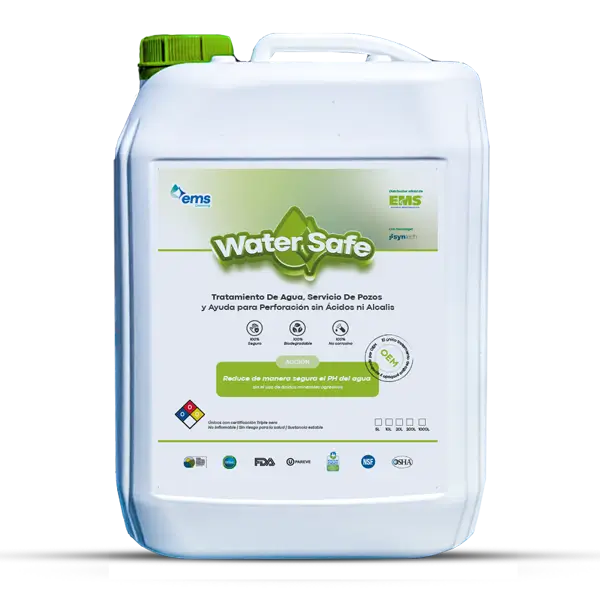
WaterSafe60 is a comprehensive solution for cleaning and maintaining water systems and industrial equipment, from EMS Cleaning. It is a controlled-acid product with an adjustable pH, designed to dissolve mineral deposits without the risks associated with nitric or phosphoric acid. See the official website for the complete technical data sheet.
Its defining feature is the Triple Zero HMIS certification: non-flammable (does not burn, ATEX-free), poses no health risk (non-toxic and non-corrosive, no harmful vapors, no corrosive PPE required), and is a stable substance (does not react with oxidizers or residual alkalis, does not polymerize).
It offers properties relevant to dairy CIP: in-line and off-line descaling, pH adjustment and control (critical for subsequent food-grade sanitization), flexible dilution up to 100%, corrosion and scale control, no ADR, and biodegradability. In a food-contact environment, it is a natural candidate to replace nitric or phosphoric acid in the acid phase, as it is effective against the major components of milkstone and does not carry the regulatory and occupational safety liabilities associated with mineral acids.
Would you like to test WaterSafe60 during the acid phase of your dairy plant's CIP cycle?
Request a free sample and a no-obligation technical evaluation.
5. Technical Comparison: Nitric Acid vs. Phosphoric Acid vs. WaterSafe60
A direct comparison of the three commonly used products in the acid phase of the dairy CIP process, with WaterSafe60 as an alternative to nitric acid in the food industry:
| Criterion | HNO₃ 68% | H₃PO₄ 75% | WaterSafe60 |
|---|---|---|---|
| HMIS / NFPA 704 | Health 3, oxidizing agent | Health 3 | Triple Zero |
| AISI 316 | Chloride-induced stinging | Stained by phosphates | Compatible |
| Titanium | Good when cold | Good | Compatible |
| ADR | Lesson 8 + 5.1 | Class 8, GE II | No ADR |
| Biodegradability | No | No | Yes |
| pH Control | Sharp Decline | Sharp Decline | Adjustable pH |
| PPE | Corrosive + respiratory | Highly corrosive | Basic food-grade |
| Landfilled Waste | Nitrates | Phosphates, eutrophication | No hazardous waste |
| Total Cost of Ownership (TCO) | Halt due to PRL and ADR | Stop for Trash | Lower TCO |
The price per liter favors mineral acids, but the total cost—EPI, ADR, insurance, waste management, HACCP documentation, and IFS/BRC audit fees—leans toward WaterSafe60. For a plant looking to transition to a biodegradable CIP cleaning solution for dairy products without sacrificing performance, switching to WaterSafe60 is a reasonable operational decision.
6. Complete 5-phase CIP procedure with WaterSafe60
A well-designed dairy CIP is carried out in five sequential phases:
Phase 1 — Pre-rinse with warm water. Mechanically removes milk residue before adding chemicals; reduces detergent consumption in subsequent phases. Temperature as per the supplier’s technical recommendations.
Phase 2 — Alkaline phase. Emulsifies fats and saponifies proteins. Traditionally performed with 50% caustic soda, but there is a biodegradable alternative: SynClean HD, a caustic soda substitute that is just as effective without the corrosiveness or occupational hazards associated with caustic soda. Dilution and processing time are determined based on the system’s requirements.
Phase 3 — Intermediate rinse. Removes alkaline residue before the acid is applied. A minor but critical step: mixing with the acid phase reduces the effectiveness of both.
Phase 4 — Acid phase with WaterSafe60. Replaces HNO₃ or H₃PO₄. The solution is recirculated through the entire circuit or over the isolated equipment in offline mode, depending on the design. The dilution ratio and duration are adjusted based on the severity of the fouling and the supplier’s recommendation. The objective is to dissolve the tricalcium phosphate and calcium carbonate in the milkstone and restore the surface to its passive state.
Phase 5 — Sanitization and final food-grade rinse. Standard sanitizer (stabilized peroxide, food-grade peracetic acid, or saturated steam) and rinse with certified drinking water. Verification via ATP swab testing, microbiological testing, and conductivity testing.
7. Specific Applications in Dairy Plants
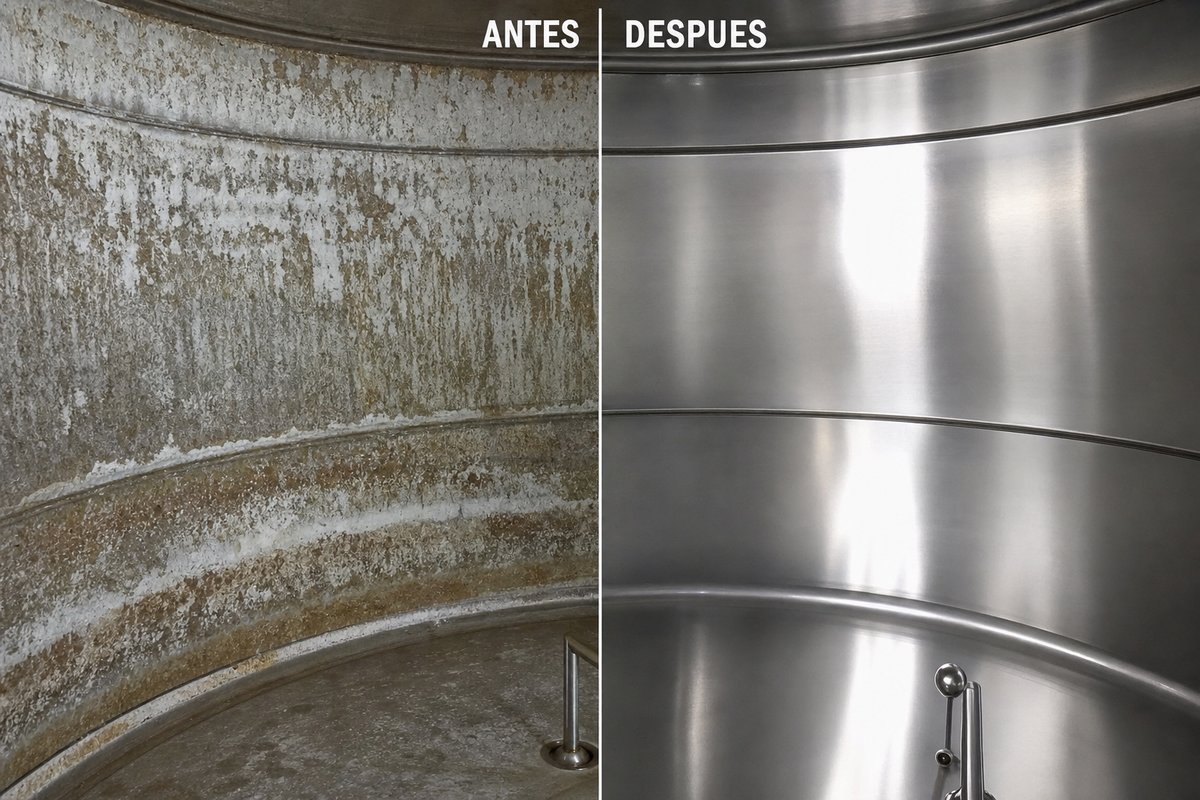
Descaling dairy equipment with WaterSafe60 addresses the critical points:
- Plate pasteurizers: the equipment most susceptible to milkstone; they restore the thermal coefficient and reduce steam consumption.
- Raw milk tanks: Dissolves the mixture of protein and salts without damaging the AISI 316 stainless steel or the gaskets.
- UHT lines: ultra-high temperature accelerates milkstone formation; the acid phase extends the cycles between shutdowns.
- Aseptic filling machines: The pre-sterilization circuits accumulate salts that interfere with thermal uniformity.
- Quesomatic and cheese presses: belts and molds work with brines that produce mixed deposits.
- On-farm collection tanks: Acid treatment during the CIP process itself prevents milkstone from being carried to the central processing plant.
8. Case Studies in the Iberian Market
Anonymized examples of scenarios where WaterSafe60 is being tested or implemented as a milk stone descaler in the Spanish dairy CIP process:
Artisanal cheese factory in Castilla-La Mancha equipped with a plate pasteurizer. Daily CIP cycles and a history of seal pitting caused by 1.5% HNO₃. Replacing the seals with WaterSafe60 is being considered to reduce the frequency of seal replacement and simplify storage, since the cheese factory does not have an ADR-approved tank.
A pasteurized milk bottling plant in northern Spain. The facility operates multiple production lines and uses significant amounts of phosphoric acid. The decision to switch is driven by two factors: eliminating phosphates from wastewater—which are subject to increasingly strict penalties from river basin authorities—and improving its ESG profile to meet the requirements of large-scale retailers.
Yogurt plant in Catalonia. Stainless-steel fermenters with recurring milkstone buildup in the preheating lines. Objective: to extend the interval between deep acid CIPs by performing the process in-line without dismantling sections.
9. Regulatory Compliance: HACCP, IFS, BRC, and ESG
Cleaning dairy plants without hazardous acids simplifies regulatory compliance:
- HACCP. Replacing HNO₃ and H₃PO₄ with a Triple Zero HMIS product reduces the list of reportable chemical hazards.
- IFS Food and BRC. A product without ADR and without GHS05/GHS06 pictograms reduces minor nonconformities during audits, and its biodegradability aligns with the reduction of chemical risk in high-care areas.
- Regulation (EC) No. 852/2004. WaterSafe60 is positioned as a Triple Zero alternative suitable for food use.
- ESG. The absence of nitrogen- or phosphate-based residues in the effluent is a verifiable selling point for large European retailers.
- Occupational Risk Prevention (Law 31/1995 and Royal Decree 374/2001). Less PPE, less specific annual training, and less enhanced health monitoring.
A dairy CIP system using WaterSafe60 in the acid phase and SynClean HD in the alkaline phase simplifies the documentation process and improves the facility’s profile in the event of any external audit.
10. Frequently Asked Questions
Does WaterSafe60 really remove limescale?
Yes. It is a controlled-acidity product with an adjustable pH, formulated to dissolve tricalcium phosphate and calcium carbonate, which are the main components of milkstone. Its effectiveness depends on the thickness of the deposit, the contact time, and the dilution ratio, which should be adjusted according to the supplier’s technical recommendations. In systems with severe buildup, a second offline pass may be required.
Is it compatible with AISI 316 and titanium?
Yes, these are the two most commonly used materials in pasteurizers, tanks, and UHT lines. Unlike nitric acid—which can cause pitting when combined with chlorides—and phosphoric acid—which can cause staining—it preserves the passive layer of stainless steel when applied at the recommended doses.
Does it replace nitric and phosphoric acids?
It is positioned as a direct alternative to HNO₃ and H₃PO₄ in the acid phase of the dairy CIP process, offering the advantages of Triple Zero HMIS—no ADRs and biodegradability. Validation is conducted on a case-by-case basis: each plant has its own combination of water hardness, contamination levels, and materials, and the protocol is tailored in consultation with EMS Cleaning’s technical team prior to the first application.
Does it leave behind residues suitable for food production?
The process is completed with a final food-grade rinse using certified drinking water, as with any conventional acid. The protocol must continue to include conductivity testing, ATP swab testing, and microbiological testing before the line is reopened for production.
What dilution should be used for a dairy CIP?
It depends on water hardness, the type of equipment, the tank wall thickness, and the frequency of CIP. WaterSafe60 allows for dilution ranging from low concentrations for preventive maintenance up to 100% for severe pipe descaling. The dosage is determined by EMS Cleaning’s technical team after evaluating the plant’s history.
11. Conclusion and Call to Action
Cleaning a dairy plant no longer requires working with 68% nitric acid or 75% phosphoric acid. The combination of WaterSafe60 in the acid phase and SynClean HD in the alkaline phase allows for a complete dairy CIP using Triple Zero HMIS biodegradable products, which are compatible with AISI 316 and titanium, ADR-free, and aligned with the ESG requirements of major European retailers. It is the technical benchmark for cheese factories, packaging plants, yogurt plants, and collection tanks seeking to professionalize their CIP processes, reduce occupational hazards, and simplify their IFS and BRC audits by 2026.
Request your free sample of WaterSafe60 for dairy CIP now
Our technical team will assess your facility and propose a customized acid-phase protocol, with no obligation.
For more information, please refer to the official WaterSafe60 product sheet or contact our technical team.
EMS Cleaning Spain — Kefi Bosque Group S.L.
Av. Jaume Recoder 88, 8th Floor, Suite 4, 08301 Mataró (Barcelona) · Tel.: +34 634 293 241 · info@emscleaning.eu