
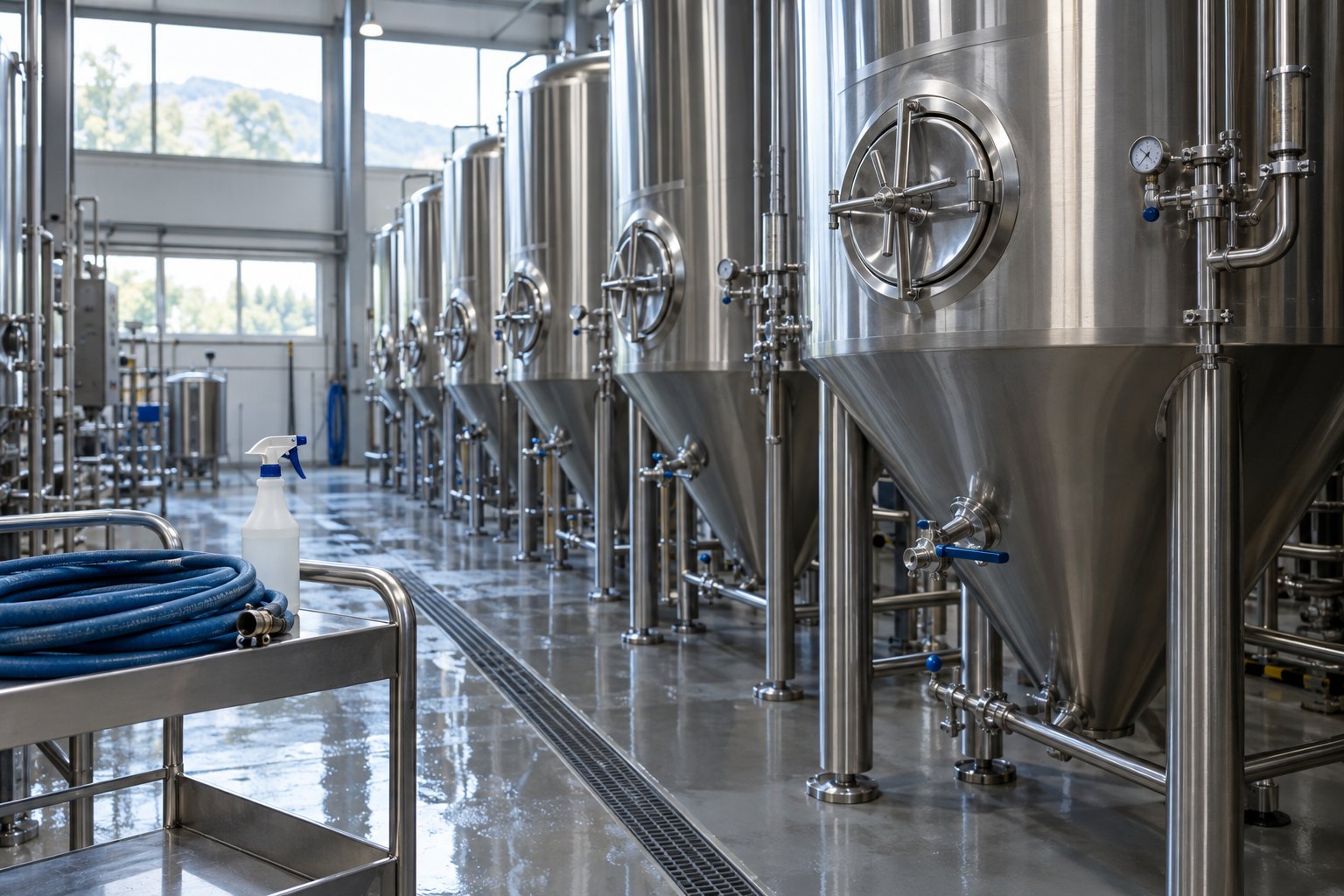
In a brewery, cleaning isn’t a secondary task—it’s part of the process. Fermentation tanks, aging tanks, pipes, joints, and floors accumulate yeast, proteins, hop residues, sugars, and, over time, mineral deposits such as beerstone. For decades, the standard solution has been caustic soda. It works, but it requires working with a corrosive product, carries a risk of burns, necessitates heavy PPE, and involves effluent management that demands careful control.
CR2 is a high-pH concentrate that the label presents as an alternative to caustic soda for cleaning and degreasing. EMS Cleaning also documents, as a separate application, the removal of fermentation residues and beerstone in breweries. This guide explains how to evaluate CR2 in a brewery without winging it: what types of residues are present, how to dilute the product according to the label, how to conduct a pilot test, and what limits should be observed.
1. What Really Makes a Brewery Messy
Before switching products, it's a good idea to categorize the different types of dirt, because they don't respond the same way to the same chemicals:
- Organic fermentation residues: yeast, coagulated proteins, hop residues, and dry foam at the top of the tanks and in the manholes.
- Greases and oils: in gearboxes, pumps, conveyor belts, the packaging area, a brewpub's kitchen, or the floor of the brewhouse.
- Mineral deposits: Beerstone is a hard layer formed by the combination of minerals in water and beer with organic residues. It typically appears in tanks, heat exchangers, and pipes where cleaning has been inconsistent.
- General dirt: floors, walls, work tables, containers, and cold storage rooms.
A common mistake is treating everything with the same product and the same concentration. The result is either excessive use or a residue that won't come off, forcing you to repeat the process. The first step in any plan involving CR2 is to identify what residue is present on each piece of equipment and on what material.
2. Why Look for an Alternative to Caustic Soda
Caustic soda (sodium hydroxide) is effective against organic dirt, but it is corrosive to the skin and eyes and requires strict procedures for handling, storage, and neutralization. In a small or medium-sized brewery, where the same team of people brews, cleans, and bottles, this burden is significant: full PPE, specialized training, the risk of splashes when preparing the solution, and pH monitoring before disposal.
The technical data sheet for CR2 describes it as a non-corrosive, non-toxic, solvent-free, and biodegradable concentrate, with NSF certification in several categories and a triple-zero rating in the HMIS system. These are the manufacturer’s claims, which should be verified against the current safety data sheet and through testing at your facility. What remains unchanged is the goal: to reduce chemical risks to staff without compromising cleaning performance.
If you are interested in replacing caustic soda in general industrial degreasing, you can also consult our guide on using SynClean HD as a substitute for caustic soda.
3. What does the documentation for CR2 say?
The product page for CR2 and its technical data sheet contain the information that should guide the evaluation:
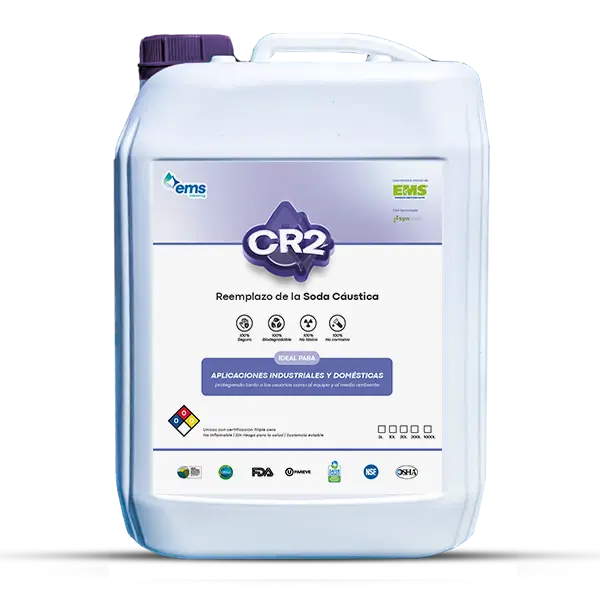
- Primary use: cleaning and degreasing of fats, oils, and petroleum residues, as an alternative to caustic soda in compatible processes.
- Documented application in a brewery: cleaning of fermentation residues and beerstone, treated as a specific case.
- Labeled dilutions: 20:1 for general cleaning, 10:1 for degreasing, and 3:1 for heavy-duty degreasing.
- Sizes: 1, 5, 10, and 20 liters.
- Restrictions: Do not mix with acids or oxidizing agents; do not apply to electrical equipment; this product is not intended for general water treatment.
The documentation emphasizes one point: the fact that the name is the same as that of caustic soda does not imply universal compatibility. Each process, material, and tank must be validated.
4. Protocol for Evaluating CR2 at a Brewery
The following protocol is intended to help you determine, based on data, whether CR2 fits into your cleaning plan. It does not replace the technical data sheet or your internal food safety procedures.
Step 1. Inventory of Equipment and Waste
Make a short list: equipment, materials (stainless steel, gaskets, plastics, painted surfaces), type of residue, and current cleaning frequency. Mark the equipment where caustic soda is currently used and the areas where beerstone appears.
Step 2. Choose a representative test site
Select a surface that clearly illustrates the problem: the manhole of a fermenter, a removable section of pipe, or a section of the brewhouse floor. Avoid starting with the most delicate or most expensive part.
Step 3. Prepare the dilution according to the label
For general dirt, start with a 20:1 ratio. For grease and stubborn organic residues, use a 10:1 ratio. For heavy-duty degreasing, use a 3:1 ratio. Always mix the product with water in a clean container, and use the protective equipment specified in the safety data sheet.
Step 4. Apply, let it sit, and scrub
The product information sheet describes spraying the solution and allowing it to act for a short time, followed by scrubbing with a sponge and rinsing thoroughly with water. On vertical surfaces, do not let the solution dry. Note the dilution ratio, the application time, and the water temperature.
Step 5. Clarify and verify
Rinse thoroughly with drinking water until the product and any loose residue are removed. Visually inspect the surface and, if your hygiene plan calls for it, document the facility’s routine inspections before resuming production.
Step 6. Document and escalate
If the result is correct, document the dilution and the procedure as a work instruction. If a mineral film remains, do not increase the concentration without monitoring it: that layer will likely require a specific descaling step.
Would you like to try CR2 at your brewery?
Tell us about the equipment, the material, and the type of waste, and we'll help you set up a pilot test, complete with a technical data sheet and a safety data sheet.
5. Organic and Mineral Phases: How to Combine Them
Most brewery cleaning programs alternate between two phases: an alkaline phase for organic matter and grease, and another phase designed to remove mineral deposits. With EMS products, the approach is as follows:
- Organic cleaning and degreasing phase: CR2, at the dilution ratio indicated on the label for the level of soiling.
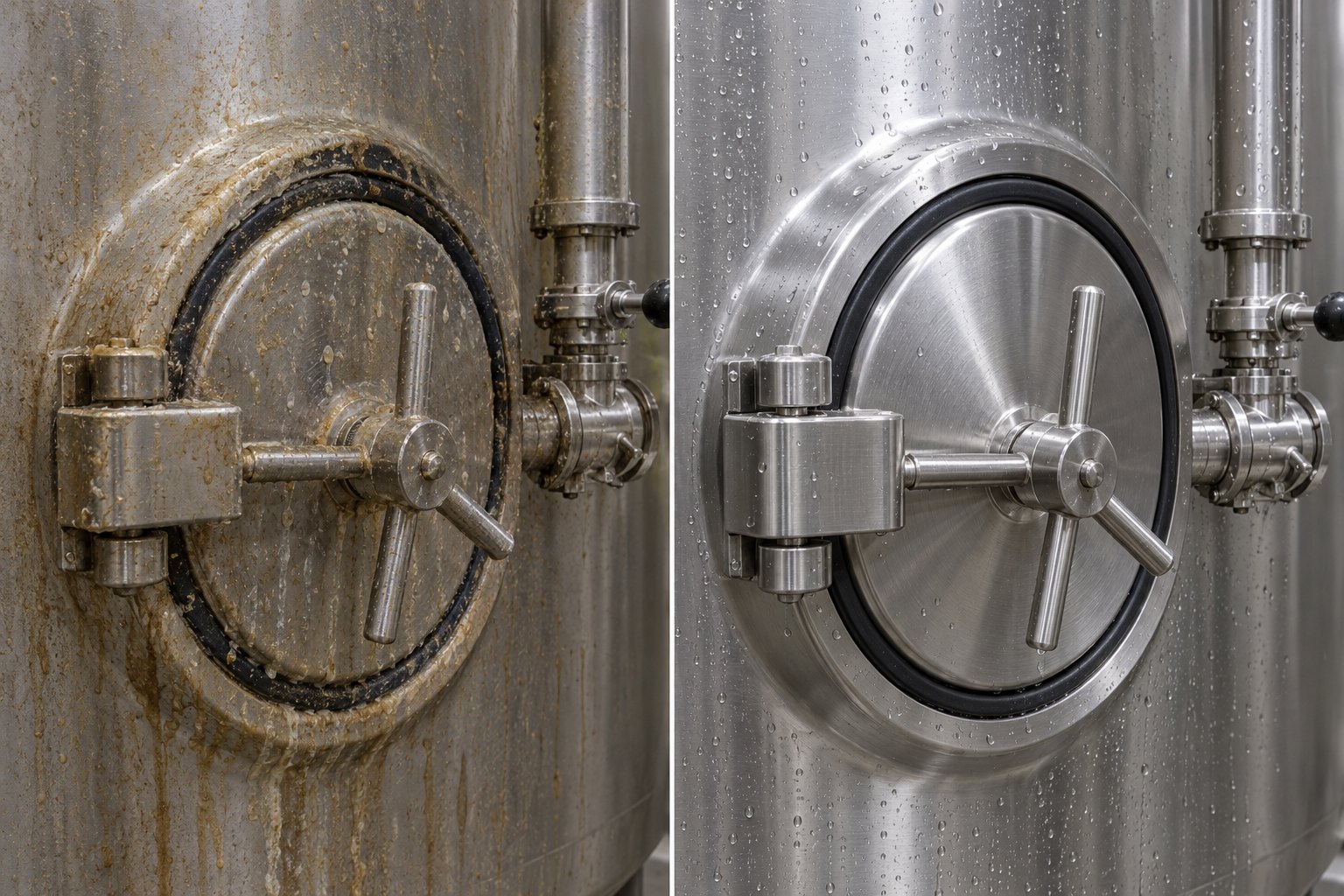
- Beerstone: CR2 has documented this application in a brewery; start with a localized trial and evaluate the results.
- Lime, calcium, and mineral deposits in isolated equipment: Blow Out documents the removal of these deposits from heat exchangers, boilers, and process equipment—including beer tanks—always with the equipment isolated and following a defined procedure.
Never mix an alkaline product with an acidic or oxidizing product in the same container or circuit. Rinse between steps. For plate or tubular heat exchangers, you can find more information in the heat exchanger cleaning guide.
6. Technical Comparison: Caustic Soda vs. CR2
The table summarizes the differences relevant to the decision. The data for CR2 is taken from its documentation; always check the current safety data sheet.
| Criterion | Caustic soda (NaOH) | CR2 |
|---|---|---|
| Nature | Strong foundation | High-pH concentrate |
| Risk to the skin and eyes | Corrosive | Described as non-corrosive and non-toxic in the technical data sheet |
| Preparation | Dissolution with a risk of exothermic reaction and splashing | Dilution with water as indicated on the label: 20:1, 10:1, or 3:1 |
| PPE | Complete protection against corrosive substances | According to the safety data sheet, gloves are required as a minimum precaution |
| Fats and Oils | Effective; breaks down fats | Documented primary use |
| Fermentation residues and beerstone | Commonly used in alkaline cleaning | Application documented at a brewery; validate through testing |
| Incompatibilities | Aluminum and light metals; acids | Do not mix with acids or oxidizing agents; do not use on electrical equipment |
7. Safety, Regulations, and Effluent Management
Changing products also changes procedures. Before introducing CR2:
- Include the safety data sheet in your chemical hazard documentation and your hygiene plan.
- Update the work instructions: dilution, contact time, rinsing, and PPE.
- Train both the cleaning staff and their supervisors, even if the product is less harsh than lye.
- Check with your service provider or the city government regarding the plant's disposal requirements. Just because a product is biodegradable does not exempt it from complying with disposal authorization requirements.
- Keep alkaline, acidic, and oxidizing products separate in the warehouse.
If you also want to reduce the use of strong acids in other plant operations, see our guide to alternatives to hydrochloric acid in industrial cleaning. For an acid-free cleaning approach in the dairy industry, you may also find the article on cleaning dairy plants with WaterSafe60 helpful.
8. Frequently Asked Questions About CR2
Does CR2 replace caustic soda in any process?
No. The label presents it as an alternative to caustic soda in compatible processes, and the EMS documentation warns that it cannot be substituted in any process without validation. Always conduct a pilot test.
What dilution should I use in a brewery?
The label specifies a 20:1 dilution for general cleaning, 10:1 for degreasing, and 3:1 for heavy-duty degreasing. Choose the dilution based on the type of residue and confirm it with a pilot test; trials at the brewery are not a one-size-fits-all solution.
Does CR2 remove the Beerstone?
Cleaning beerstone in breweries is a documented application of CR2. Since the thickness and composition of the deposit vary, start with a localized test. If a mineral film remains, consider a specific descaling process.
Can CR2 be used in a CIP circuit?
The documentation does not specify a universal CIP procedure for CR2. Its use in operation must be defined based on the system parameters: materials, temperature, flow rate, and rinse. Consult EMS before incorporating it into an automated cycle.
Can I mix CR2 with an acid or a disinfectant?
No. CR2 must not be mixed with acids or oxidizing agents. If your regimen includes other steps, apply them separately and rinse between each step.
Conclusion: Clean the brewery with less chemical risk
Replacing caustic soda in a brewery is possible when done systematically: diagnose the residue, select the dilution specified on the label, test at a representative point, and document the results. CR2 offers a documented approach for cleaning and degreasing, as well as for fermentation residues and beerstone, with a simpler handling profile according to its product data sheet. The key is to validate the process at your facility before scaling up.
Set up your pilot test with EMS Cleaning
We will send you the technical data sheet and safety data sheet for CR2 and help you determine the dilution ratio and procedure for your equipment.