Limescale is a silent enemy of any boiler. Each heating cycle leaves a thin layer of carbonates, calcium, and other minerals on the heat exchange surfaces. Over time, this layer acts as an insulator: heat transfers less efficiently from the burner to the water, the system has to work harder to provide the same output, and areas with the most scale buildup experience greater thermal stress. Added to this is rust, which forms in circuits with oxygen ingress or during prolonged shutdowns.
The traditional solution has been acid: hydrochloric (muriatic), phosphoric, or commercial mixtures. They work, but they require managing vapors, pose a risk of burns, cause corrosion of metals and gaskets, and require careful neutralization before disposal. That is why more and more maintenance managers are looking for alternatives.
Blow Out is EMS's acid-free descaling agent for industrial equipment and circuits. In this guide, we explain what Blow Out is intended for, how to plan a boiler descaling process using it, what to monitor during the process, and what limits must be observed.
1. What problems does scale buildup cause in a boiler?
In a plant, the effects of lime and rust usually appear gradually:
- Poorer heat transfer. The mineral layer acts as a barrier between the flame or hot gases and the water.
- Higher fuel consumption to maintain the same output of steam or hot water.
- Unplanned shutdowns due to localized overheating, blockages, or sensor and valve failures.
- Shorter service life of tubes, plates, and components subjected to thermal cycling with scaling.
- Reduced flow in associated circuits and heat exchangers when deposits break loose and accumulate.
Periodic descaling is part of preventive maintenance, along with feedwater treatment and blowdowns. What changes is the chemistry used in the process.
2. What is Blow Out and what is it documented for?
According to the product page for Blow Out and its technical data sheet, Blow Out is an acid-free, non-corrosive descaling solution for removing limescale, calcium, rust, and mineral deposits from industrial equipment that is not in service.

The documented applications are as follows:
- Boilers.
- Heat exchangers.
- Processing equipment with milkstone and beerstone deposits.
The technical data sheet also mentions cooling towers, evaporative coolers, and industrial refrigeration systems, with specific procedures for each case. In this guide, we focus on boilers.
Key product features, according to the manufacturer:
- Acid-free and non-corrosive to equipment in the documented applications.
- Biodegradable, vapor-free, and odorless.
- Can be neutralized with water, which simplifies handling and rinsing.
- Triple-zero rating in HMIS (health, flammability, and reactivity), and NSF 60 and Kosher certifications as stated by the manufacturer.
- Available in 1-, 5-, 10-, and 20-liter sizes.
This information is provided by the manufacturer. Before using the product, review the current technical data sheet and safety data sheet.
3. What Blow Out is not
It's a good idea to set boundaries from the start:
- This is not a water treatment for use in service. It should not be added to drinking water that is in use or to a full swimming pool. The equipment must be isolated during use.
- It is not a disinfectant. We do not make any claims regarding the elimination of Legionella or disinfection. There are specific protocols and products for that purpose.
- There is no one-size-fits-all dosage. The concentration, circulation, contact time, and rinsing are determined based on the type of scale, the volume, and the materials of the equipment.
- It is not automatically compatible with all metals. Some galvanized metals may change color. Alloys, joints, and coatings must be verified before selecting the procedure.
4. Before You Begin: Preparing the Boiler
A properly done descaling process begins before you even open the first container:
- Identify materials: steel, copper, brass, galvanized steel, gaskets, and coatings on the boiler body and connected components.
- Determine the volume of water in the system to be treated. Without this information, the solution cannot be prepared.
- Assess the type and thickness of the scale. Light lime scale, hard scale, or rust. If possible, inspect through a manhole or remove a sample.
- Isolate the equipment. Shut down, cool down, lock out, and tag out in accordance with plant procedures. The boiler must not be in service or under pressure.
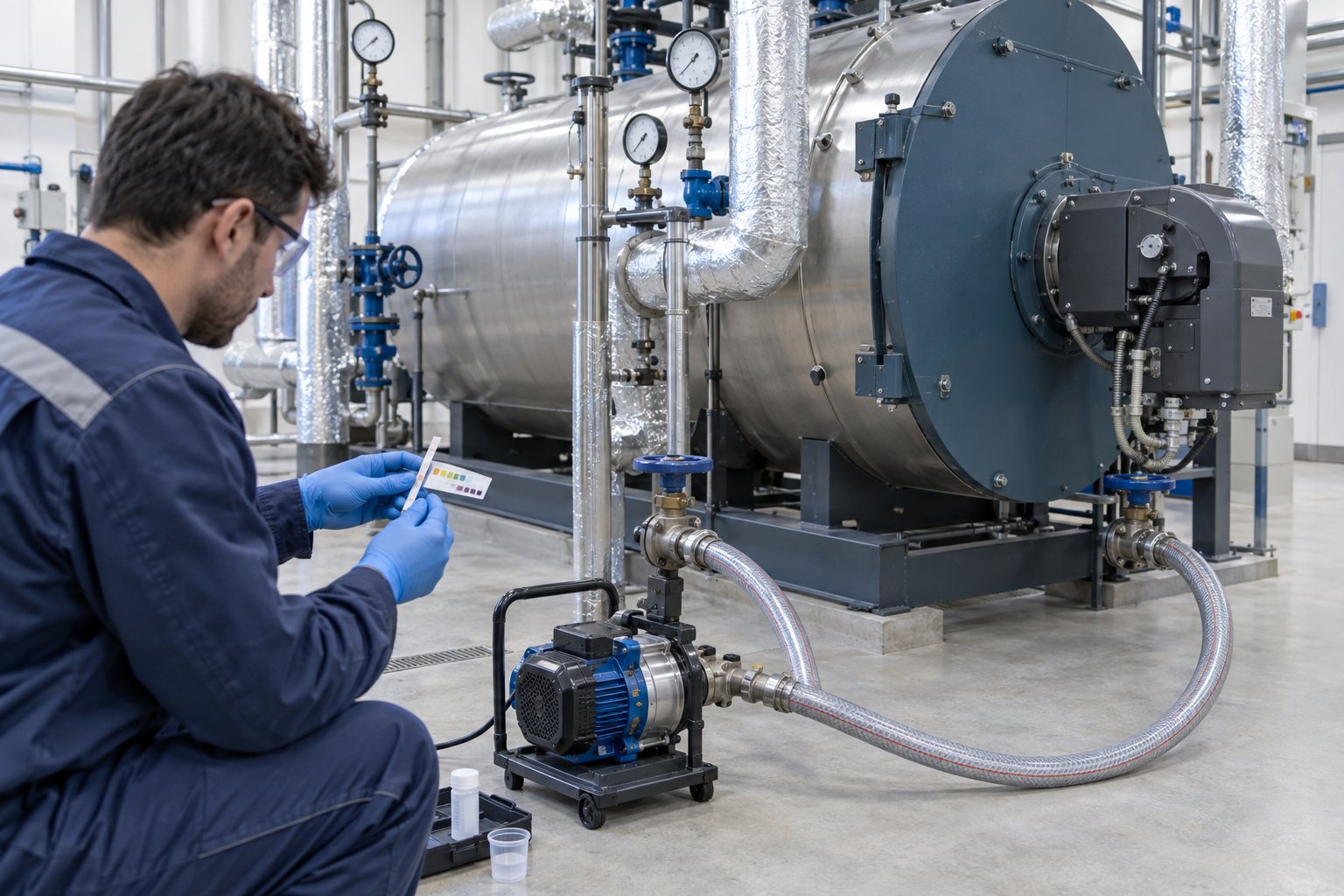
- Set up the circulation system. Use a pump, hoses, and appropriate connections for a closed-loop system, or plan the soaking method.
- Have pH strips, rinse water, and a plan for effluent management in accordance with local regulations on hand.
If you have any questions about compatibility or volume, please consult with the EMS technical team before you begin.
5. How to descale a boiler with Blow Out
The technical data sheet describes two methods for boilers: closed-loop circulation and soaking. Below is a summary of the logic behind each method. The specific proportions and times should be taken from the current technical data sheet and adjusted for your equipment in consultation with EMS’s technical staff.
Circulation Method
- Prepare the Blow Out solution based on the boiler's water volume, as indicated in the technical data sheet.
- Enclose the boiler and its components to form a closed circuit.
- Circulate the solution using the pump for the time specified for the size of the equipment.
- Check the solution periodically with pH strips. According to the manufacturer, if the strip turns red, the product is still active. If not, add more product.
- Drain, rinse with water, refill, and check.
Soaking Method
When circulation is not practical, the technical data sheet recommends filling the boiler with a mixture of Blow Out and water and allowing it to sit for the specified time, while periodically checking the pH using pH test strips. Afterward, drain and rinse the system.
After descaling
- Rinse thoroughly with clean water before putting the equipment back into service.
- Inspect accessible surfaces and manholes.
- Record the date, method, volume treated, and condition of the equipment before and after. This record is the best basis for determining the frequency of future descaling.
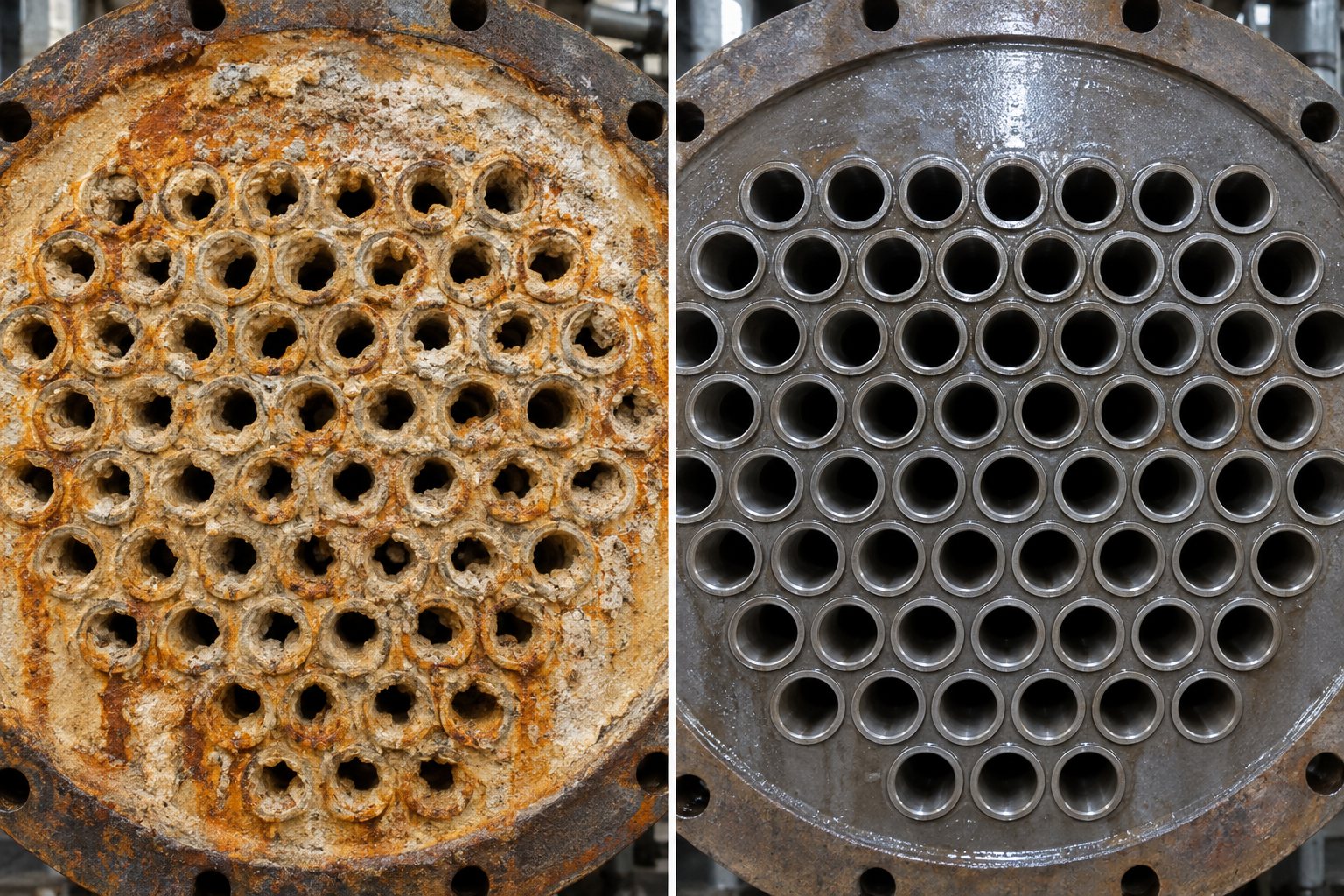
Illustration: A bundle of boiler tubes with lime and rust deposits (left) and after descaling (right). This image is for illustrative purposes only and does not correspond to a test.
6. Comparison: Blow Out vs. Acid Scale Removers
The table summarizes general differences between the most common approaches. It does not compare measured performance, because performance depends on the type of embedding, the equipment, and the procedure.
| Appearance | Hydrochloric acid (muriatic acid) | Phosphoric or sulfamic acids | Blow Out |
|---|---|---|---|
| Nature | Strong acid | Acids with a milder effect | Acid-free descaler |
| Vapors and Odor | Corrosive and irritating vapors | Minor, but require ventilation | Vapor-free and odorless, according to the manufacturer |
| Risk to metals and gaskets | High; usually requires inhibitors | Moderate; depends on the material | Non-corrosive in documented applications; check galvanized parts and gaskets |
| Handling and Transportation | Hazardous materials; full set of PPE | Precautions for Corrosive Products | Triple Zero in HMIS; follow the safety data sheet |
| Process Control | Acidity Measurement and Inhibitor | Acidity Measurement | pH strips: if the strip is red, the product is still active |
| Effluent | Mandatory neutralization prior to discharge | Phosphate Neutralization and Control | Biodegradable and neutralizable with water; comply with local regulations |
Replacing an acid is not just a matter of performance. It also reduces the risk to personnel, simplifies storage, and makes it easier to assess chemical hazards at the plant.
7. Boilers in the Food and Beverage Industry
In dairy, brewery, and other food processing plants, boilers and heat exchangers are located in the same area as the production process. In these settings, reducing the presence of strong acids offers added value for hygiene and risk prevention plans.
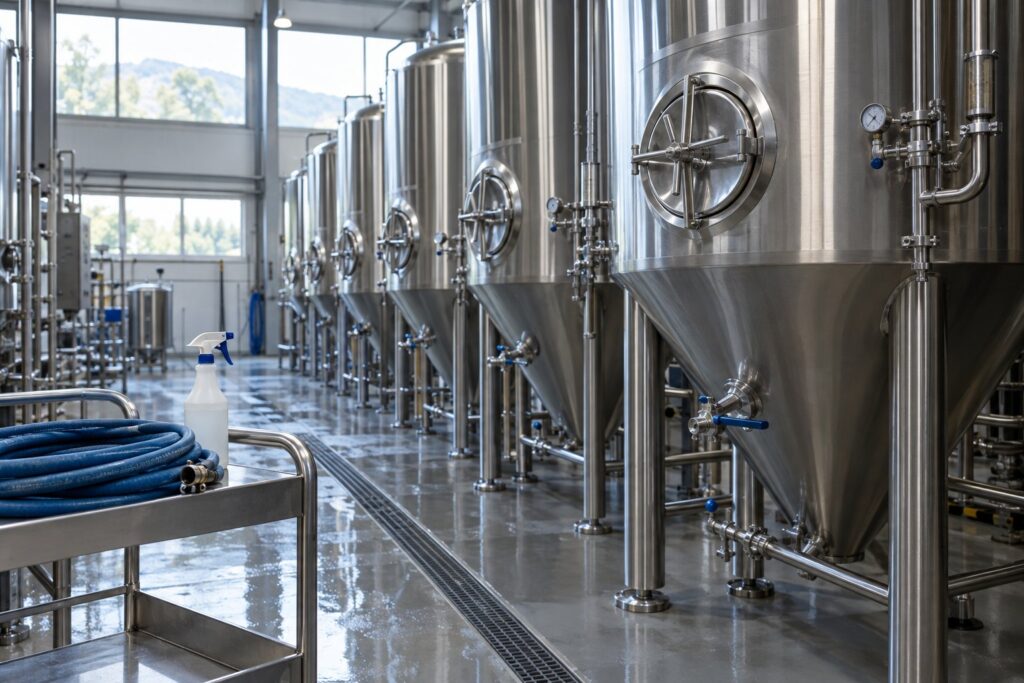
Blow Out is also documented for processing equipment with milkstone and beerstone deposits. It fits in with the rest of the EMS product line for these industries:
- For cleaning dairy processing lines and tanks, see the guide on acid-free cleaning of dairy plants with WaterSafe60.
- For breweries, the guide to cleaning breweries without caustic soda, with CR2.
- If the problem with the heat exchanger is grease or organic residue rather than limescale, the recommended product is SynClean HD. We explain this in the guide on cleaning heat exchangers with SynClean HD.
If you're looking for an overview of alternatives to acid, see the guide on alternatives to hydrochloric acid in industrial cleaning.
Are you planning to descale a boiler?
Please tell us the type of boiler, the water volume, the materials, and the type of scale. We'll help you prepare the procedure using Blow Out.
8. Safety and Best Practices
Although Blow Out is considered low-risk by the manufacturer, best practices remain essential:
- Read the safety data sheet before using the product for the first time.
- Wear appropriate safety glasses and gloves.
- If the product comes into contact with your eyes or skin, rinse thoroughly with water.
- Always work with the boiler shut down, cool, depressurized, and locked out.
- Do not mix Blow Out with other chemicals in the system.
- Rinse empty containers with water and dispose of wastewater and containers in accordance with local regulations.
9. Frequently Asked Questions About Blow Out
Is Blow Out compatible with any boiler?
It is approved for use on boilers, heat exchangers, and process equipment that are out of service. Before use, verify the materials: alloys, gaskets, and coatings. Some galvanized metals may change color.
What dose of Blow Out do I need?
There is no one-size-fits-all dosage. The technical data sheet provides guideline ratios for each method, but the concentration, duration, and rinse are determined based on the volume, the type of scale, and the materials. The EMS technical team can help you calculate these based on your system's specifications.
How do I know when the descaling is finished?
The technical data sheet recommends monitoring the solution with pH strips during the process. If the strip turns red, the product is still active; if not, more must be added. At the end, the solution is drained, the equipment is rinsed, and it is inspected.
Can Blow Out be used while the boiler is in operation?
No. The equipment must be isolated. Blow Out is not a water treatment product for use in the water system, nor should it be dosed into drinking water that is in use.
Does Blow Out eliminate Legionella?
We make no claims regarding the elimination of Legionella or disinfection. Blow Out is a scale remover. Legionella control requires specific protocols and products in accordance with current regulations.
Conclusion
Descaling a boiler should not force you to choose between efficiency and safety. With Blow Out, limescale, calcium, rust, and mineral deposits can be removed using an acid-free product, provided the following conditions are met: the equipment is out of service; the materials are approved; the procedure is tailored to the volume and type of scale; pH is monitored using test strips; and the system is thoroughly rinsed.
The next practical step is to gather the data on your boiler and review the procedure with our technical team.
Talk to the technical team at EMS Cleaning
We'll review the materials, the amount, and the type of buildup with you to prepare for the scaling procedure using Blow Out.