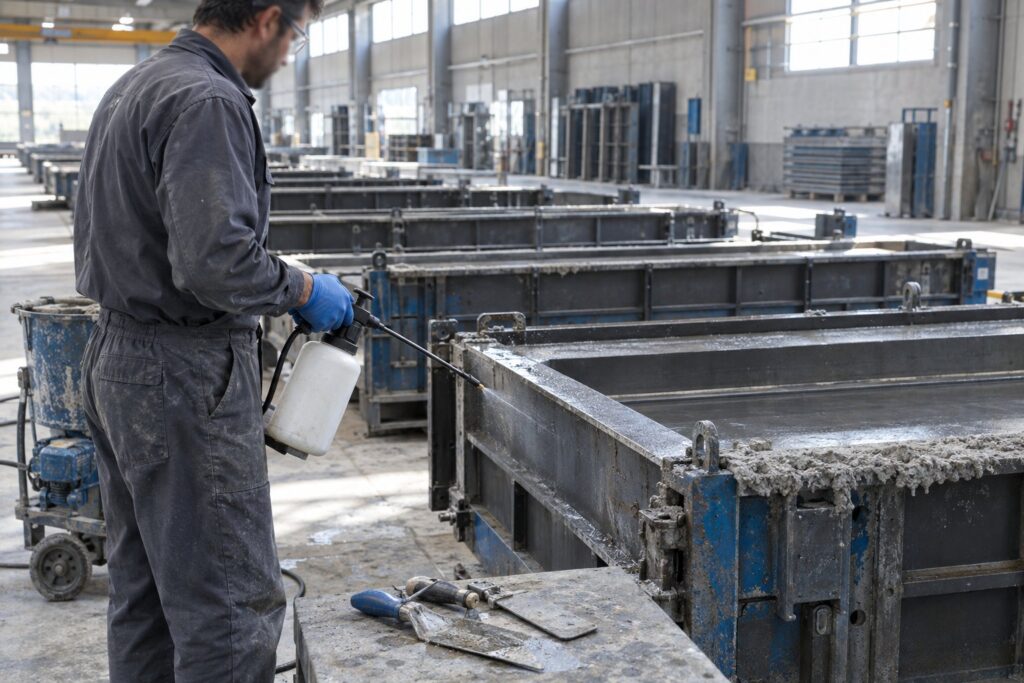

Anyone in charge of a fleet of concrete mixers knows the problem: after each delivery, a thin layer of concrete remains in the drum and on the paddles. If it isn’t removed in time, it sets, builds up on top of the previous day’s layer, and, weeks later, the truck is carrying kilos of hardened concrete that nobody ordered. The traditional solution is a hammer, chisel, or acid. Both options require hours of shop time, wear down the equipment, and expose staff to risks.
There is another approach: acting before the concrete adheres. Fusion RM is EMS’s preventive anti-adhesive treatment for the interiors of concrete mixer drums and blades, as well as other equipment. In this guide, we explain what Fusion RM does, what it doesn’t do, how to prepare the surface, how to apply and dry it, and how it works in conjunction with the removal of hardened concrete using Barracuda 10K.
1. Why Concrete Builds Up in the Drum
Fresh concrete contains cement, aggregates, and water. When the drum rotates, a thin layer of paste remains on the metal sheet, the welds, and, above all, the helical fins. If the drum is not thoroughly washed at the end of the day, that paste sets and creates a rough surface. On a rough surface, the next load adheres even better. This is how the buildup begins.
The consequences are well known at any ready-mix concrete plant:
- More dead weight per trip and less usable drum capacity.
- Worse discharge, with debris getting trapped between the fins.
- More wash water at the end of each shift.
- Work stops to chip away at hardened concrete—a slow, noisy, and dangerous task, often performed in a confined space.
- Wear and tear on the fins and sheet metal caused by impacts and tools.
Daily cleaning with water is still essential. But cleaning alone doesn't change the surface of the drum. That's where a nonstick coating comes in.
2. What is Fusion RM and how does it work?
According to the product page for Fusion RM and its technical data sheet, Fusion RM is an anti-adhesive agent designed for the interior treatment of concrete mixers and other equipment. It is applied to a prepared surface, allowed to dry, and forms a barrier that helps reduce the adhesion of concrete to the inner walls and the drum blades.
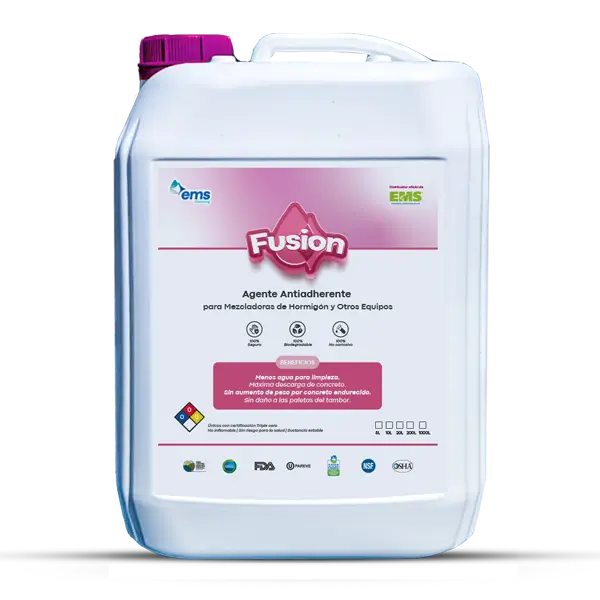
The key points of the documentation are as follows:
- Function: Preventive anti-fouling treatment. It is not a cleaner or a descaler.
- Compatible surfaces: unpainted and uncoated steel and certain compatible composite materials, on properly prepared concrete mixer drums and blades.
- Directions: Use undiluted.
- Conditions: Surface temperature above +5 °C during application and drying, and at least 12 hours of drying time.
- Product Profile: The technical data sheet describes it as free of epoxy and butyl, non-flammable, and with a triple-zero classification in the HMIS system. This information is provided by the manufacturer and should be reviewed along with the current safety data sheet.
The benefits described by the manufacturer point in the same direction: less water needed for cleaning, better concrete discharge, less weight from hardened concrete inside, and less damage to the blades, since there is no need to chip away at the concrete.
3. What Fusion RM does not do
To plan effectively, it's a good idea to clearly define the limits, because they're just as important as the benefits:
- It does not remove hardened concrete. If there are layers of buildup on the drum, they must be removed first. Fusion RM does not work through concrete, paint, oil, release agents, or other foreign materials.
- Do not apply to paint or unknown coatings. If you do not know what is on the surface, do not apply it until you have confirmed it.
- Do not allow water to come into contact with the product while it is drying. Any water that enters the drum before the product is dry will cause the application to fail.
- It is not a disinfectant and does not replace daily cleaning of the equipment.
- Do not enter the drum. Working inside a drum constitutes work in a confined space. It requires an approved entry, lockout, and ventilation procedure from your company. Do not improvise an entry.
4. Before application: Remove the hardened concrete
The correct order is always the same: first, a clean, dry drum, then Fusion RM.
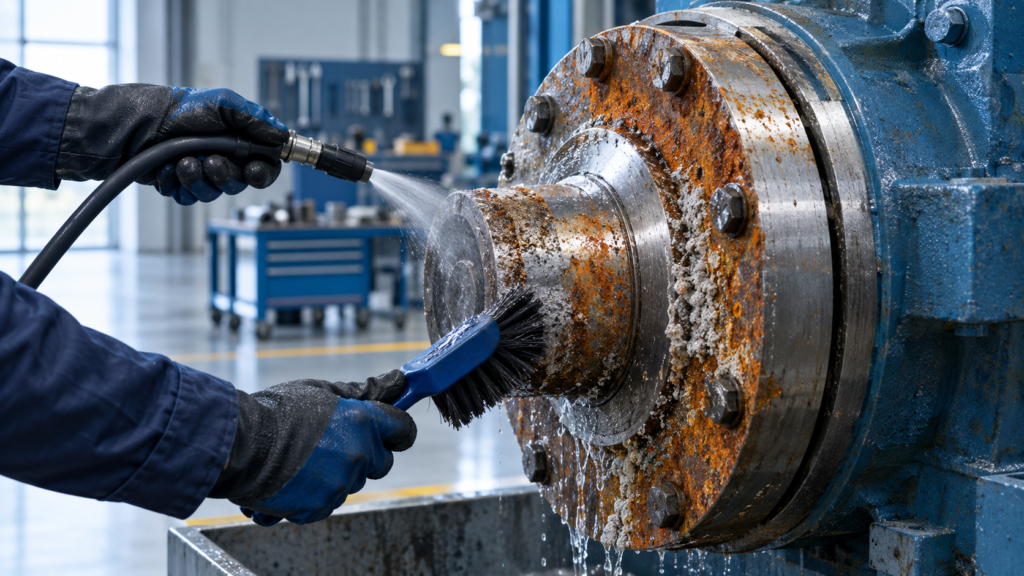
If the drum already has buildup, chemical removal is the alternative to using a hammer. Barracuda 10K is documented to remove hardened concrete, cement, and mortar from concrete mixers, molds, and tools. In our guide on how to remove hardened concrete without hydrochloric acid, we explain the procedure and material precautions. If you’re looking for a general cleaning plan for your fleet, also see the guide on cleaning concrete mixer trucks without acid.
After removal, the drum must be cleaned according to the Barracuda 10K data sheet and allowed to dry completely. Applying Fusion RM to a damp surface or one with residue is the most common cause of poor results.
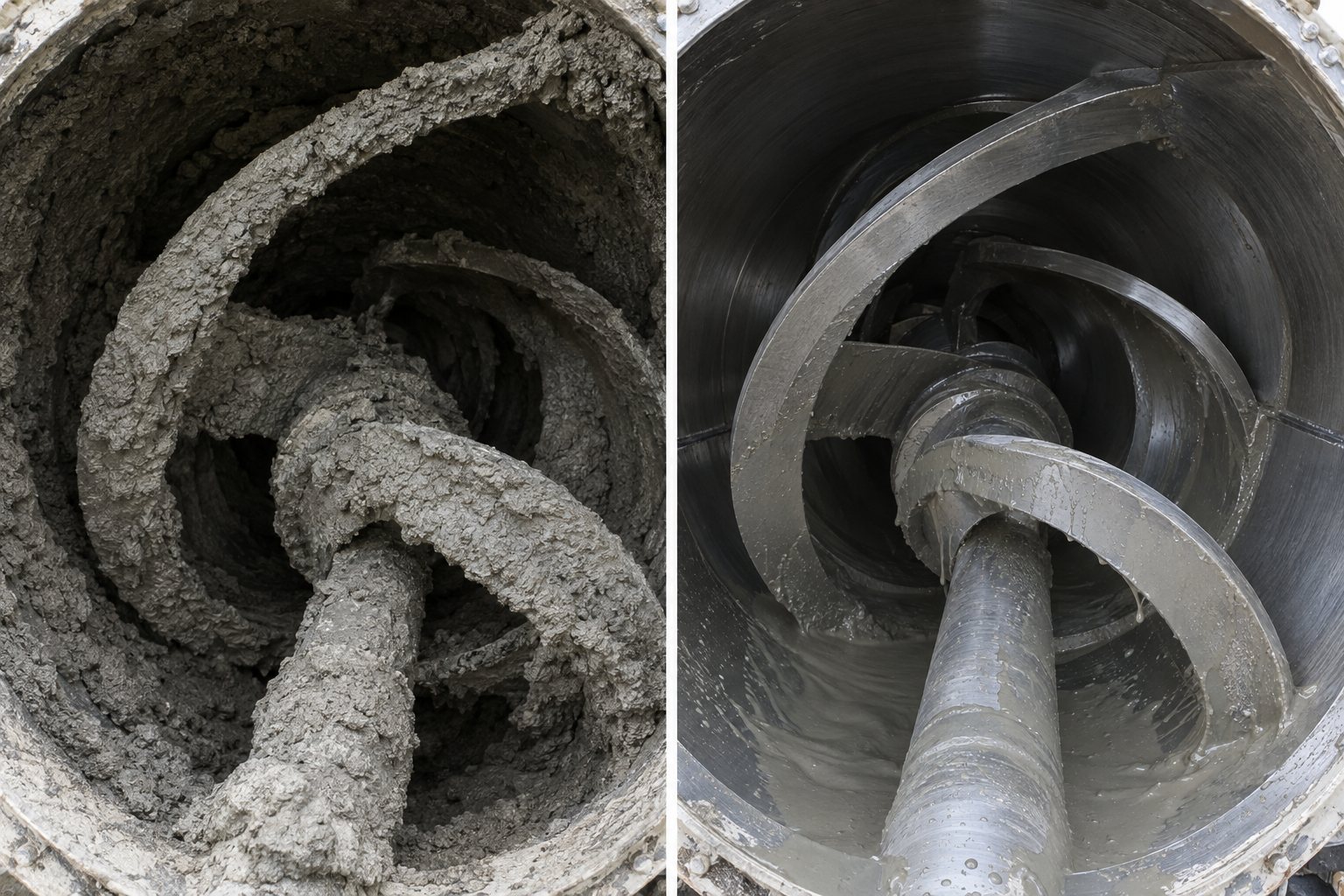
Illustration: Drum with a buildup of hardened concrete (left) compared to a clean, treated drum, where the fresh concrete does not adhere (right). This image is for illustrative purposes only and does not correspond to a test.
5. How to Apply Fusion RM Step by Step
The following procedure summarizes the technical data sheet. It does not replace the manufacturer's current guidelines or your company's safety procedures.
Step 1. Check the materials
Confirm that the interior surface is unpainted, uncoated steel or an approved composite material. If the drum has paint, a coating of unknown origin, or repairs made with other materials, consult the technical team first.
Step 2. Prepare the surface
The drum must be clean, dry, and free of concrete, paint, oil, and release agents. If it was necessary to remove hardened concrete, allow sufficient time for the interior to dry completely.
Step 3. Monitor the temperature
The metal's temperature must be above +5 °C during application and throughout the drying process. In winter, the instructions recommend parking the concrete mixer indoors so that the metal can warm up. Once the treatment has dried, the drum can be used at any temperature.
Step 4. Apply undiluted
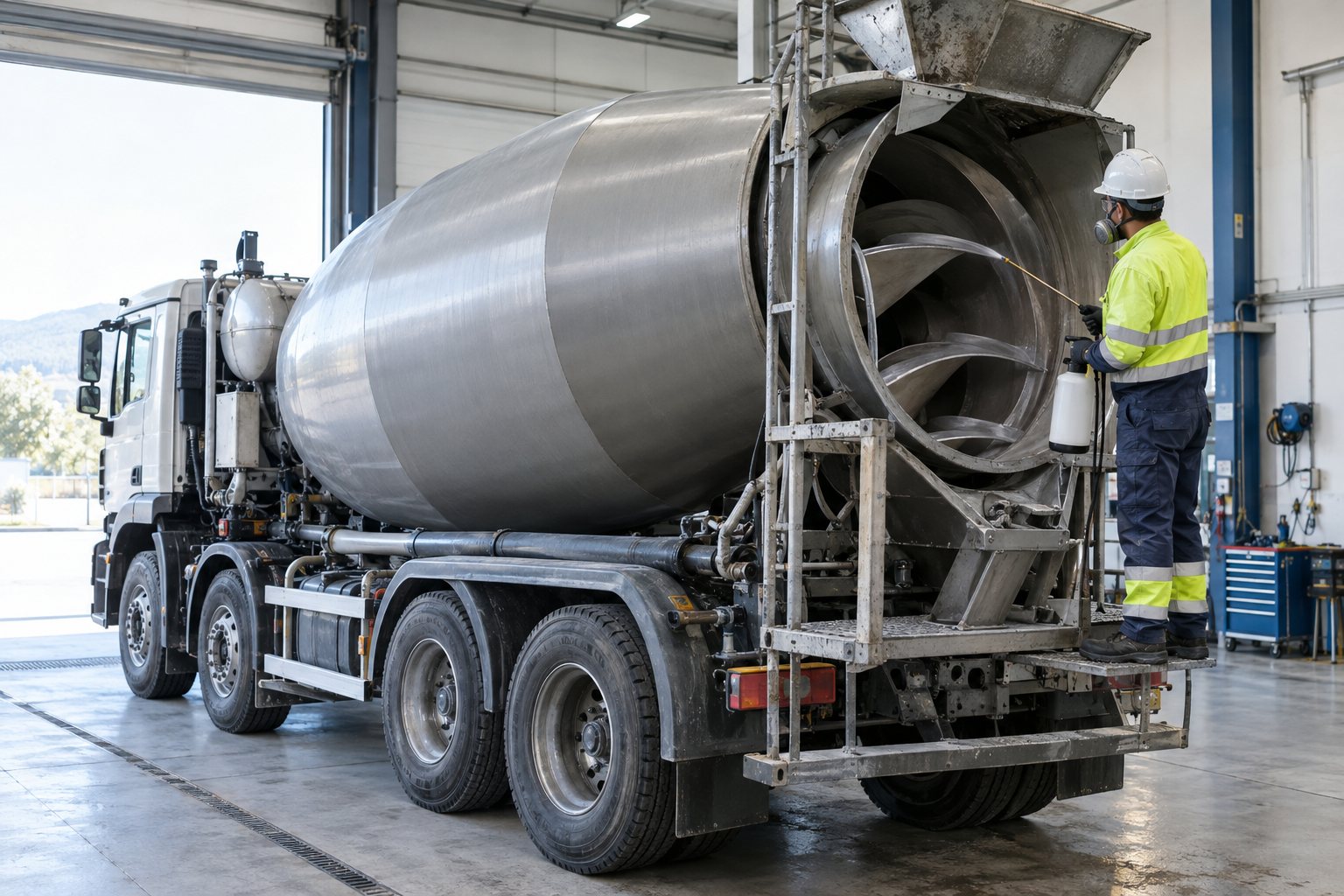
The technical data sheet specifies a simple manual sprayer, such as a garden sprayer, and advises against using pneumatic sprayers with a compressor or other fine-mist spraying systems. It is recommended to wear a mask, especially in confined spaces, and to work in well-ventilated areas. For reference, the technical data sheet specifies a minimum quantity of 7 liters for an 8 m³ drum. Confirm the amount for your specific equipment using the current guidelines.
Step 5. Let it dry for at least 12 hours
We recommend applying the product during the day and letting it dry until the next day. The actual drying time depends on the ambient temperature and humidity. During this time, no water should enter the drum—not from rain, washing, or loading.
Step 6. Resume service and plan for reapplication
After drying, the concrete mixer returns to normal operation, with the usual daily cleaning routine. The technical data sheet recommends repeating the application every 1,500 m³ of concrete delivered or as needed. It is practical to record the cubic meters for each truck and inspect the drum at each maintenance stop.
6. Comparison: Prevention vs. Removal
The following table summarizes the common options for handling concrete in the drum. It does not compare performance, as this depends on the equipment, the type of concrete, and the cleaning procedure.
| Option | When to Use It | Advantages | Limits |
|---|---|---|---|
| Fusion RM (preventive) | On a clean, dry drum, before concrete builds up | Helps reduce buildup; less rinse water and better flushing, according to the manufacturer | It does not remove hardened concrete; requires a suitable surface, a temperature above +5 °C, and 12 hours of drying time |
| Barracuda 10K (chemical removal) | When there is already hardened concrete, cement, or mortar | An alternative to chipping and hydrochloric acid for concrete mixers, molds, and tools | Confirm compatibility with the material; follow the instructions for contact and rinsing |
| Mechanical chopping | Heavy deposits with no chemical alternative | No product needed | Slow, noisy, wears down the blades, and often requires work in confined spaces |
| Hydrochloric acid | Traditional descaling practice | It acts quickly on cement | Corrosive to metal and hazardous to personnel; vapors and waste management |
| Wash with water only | Daily routine at the end of each shift | Essential and simple | The drum's surface does not change; the buildup starts over |
The practical conclusion is that it’s not a matter of choosing one or the other. The most effective approach combines all three steps: daily washing, occasional chemical cleaning with Barracuda 10K when buildup occurs, and preventive treatment with Fusion RM on the already-clean drum.
7. A maintenance plan for the fleet
For a fleet or plant manager, the easiest way to implement Fusion RM is in phases:
- Choose a pilot truck. Preferably one with a track record of performance, including data on shop hours and cubic meters delivered.
- Record the initial conditions. Take photos of the inside of the drum and the paddles, note the daily washing time, and record the date of the last concrete removal.
- Keep the drum clean. If there is any buildup, remove it with Barracuda 10K, rinse, and dry.
- Apply Fusion RM according to the technical data sheet, keeping the truck under cover if it is cold.
- Check after each maintenance stop. Take photos from the same position and record the number of cubic meters delivered.
- Use data to decide whether to extend the treatment to the rest of the fleet and how often to reapply it.
For the rest of the vehicle—such as the cab, chassis, or areas with grease and general dirt—use a hard-surface cleaner such as Fortis. Fortis is not intended for removing hardened concrete. We explain its use in the guide on acid-free industrial cleaning in waste areas.
8. Safety and Documentation
Fusion RM is considered low-risk, but that doesn't mean best practices can be ignored:
- Read the safety data sheet before using the product for the first time.
- Wear a mask and goggles, and work in well-ventilated areas.
- Avoid contact with the eyes; if contact occurs, rinse thoroughly with water.
- Keep this product out of the reach of unauthorized persons.
- For any work inside a drum, follow your company's confined-space procedures: lockout, work permit, ventilation, and external monitoring.
- When the container is empty, rinse it with water and dispose of it in accordance with local regulations.
Would you like to test Fusion RM on a pilot truck?
Tell us the material in the drum, the type of concrete, and how you currently clean your fleet. We'll help you prepare for the test with Fusion RM and, if necessary, the preliminary removal with Barracuda 10K.
9. Frequently Asked Questions About Fusion RM
Does Fusion RM remove the concrete that is already stuck to the drum?
No. Fusion RM is a preventive treatment. It does not work through concrete, paint, oil, or other materials. If there is buildup on the drum, it must first be removed—for example, with Barracuda 10K—and the surface must be left clean and dry.
On what surfaces can it be applied?
According to the documentation, this product is intended for use on unpainted and uncoated steel and on certain compatible composite materials, on properly prepared drums and fins. It is not recommended for use on paint or coatings of unknown origin.
How long does it take to dry?
At least 12 hours, with the surface temperature remaining above +5 °C throughout the process. It is recommended to apply the product during the day and let it dry until the next day, ensuring that no water enters the drum.
How often should it be reapplied?
The technical specifications indicate that the application should be repeated every 1,500 m³ of concrete placed or as needed. It is recommended that you inspect the drum at each maintenance stop and adjust the frequency to suit your fleet.
Can it be used in the winter?
Yes, as long as the metal remains above +5 °C during application and drying. In the winter, it’s a good idea to bring the concrete mixer into a warehouse so the metal can warm up. Once dry, the drum can operate at any temperature.
Conclusion
Concrete buildup in the drum cannot be resolved simply by scrubbing harder. It requires a plan: daily washing, chemical removal of hardened concrete when present, and a preventive treatment that reduces adhesion from the start. Fusion RM addresses this last aspect, provided its conditions are met: a suitable, clean, and dry surface; a temperature above +5 °C; 12 hours of drying time; and periodic reapplication.
If you manage a ready-mix concrete plant or a fleet of concrete mixers, a pilot truck is the fastest way to see how Fusion RM fits into your operation.
Talk to the technical team at EMS Cleaning
We'll review with you the condition of the drums, the necessary preparations, and the application procedure for Fusion RM for your fleet.