
Acid-Free Industrial Cleaning: How to Use Fortis in Waste Areas and Food Processing Plants
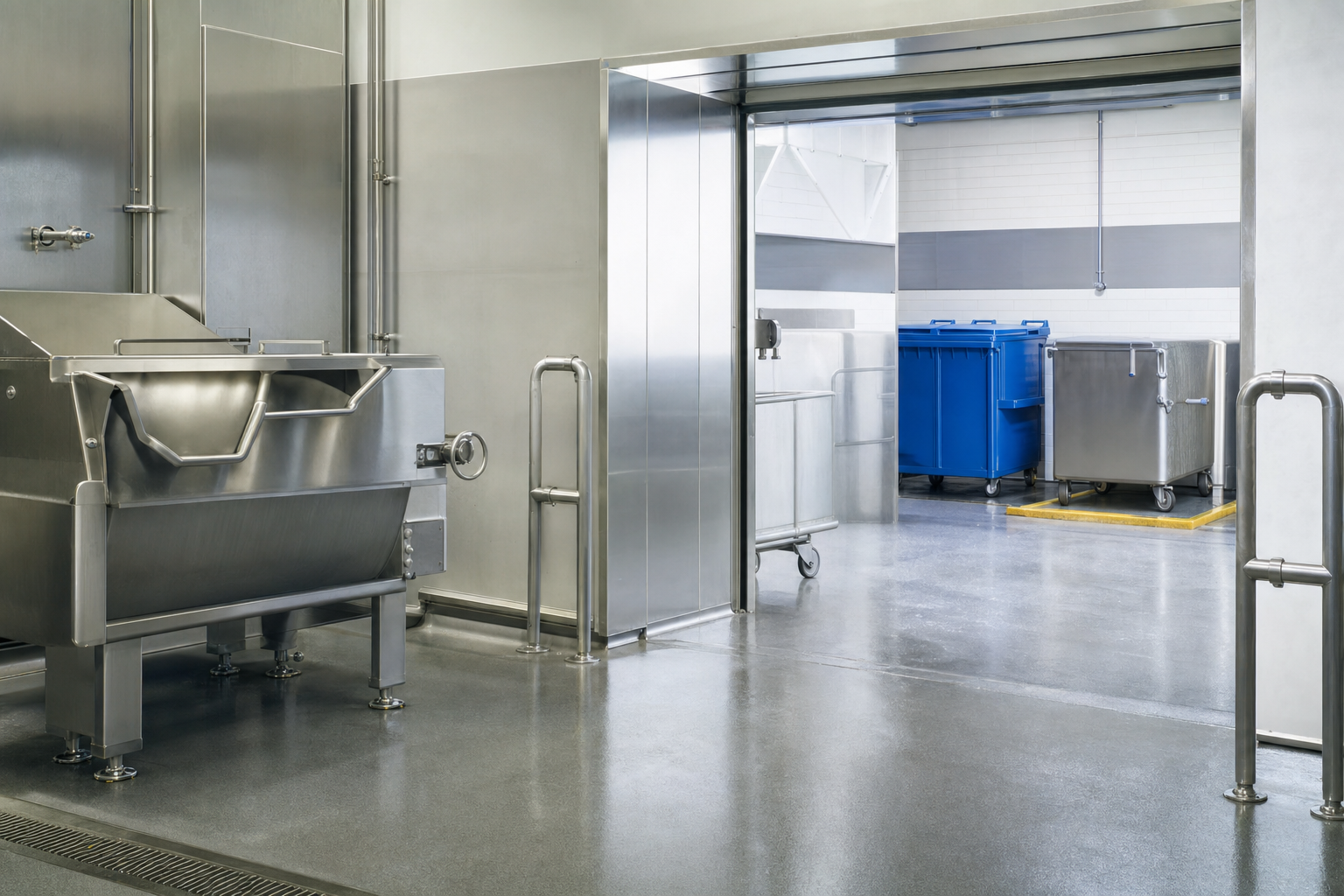
Acid-free industrial cleaning is no longer simply a matter of replacing one product with another. Whether in a food processing plant, a waste area, an industrial bathroom, or outdoor equipment, acid-free industrial cleaning must simultaneously address dirt, odors, surface compatibility, operator safety, and the documentation required by hygiene protocols. In acid-free industrial cleaning, the challenge is even greater when traditional procedures rely on acidic or caustic cleaners to remove limescale, grease, stubborn stains, and accumulated dirt.
Fortis, from EMS Cleaning, is designed as a universal cleaner for various surfaces and environments. The official technical information describes it as a 100% biodegradable, non-corrosive, and non-toxic formula with deodorizing properties and XTREME technology. It also states that it can replace traditional acidic and caustic cleaners and that it can be used on surfaces such as metal, stainless steel, rubber, plastic, painted surfaces, tile, and chrome. In this article, we explain where it fits in, how to design a technical test, and what points should be validated before incorporating it into a cleaning plan.
1. Why Use Alternatives to Acids and Caustic Substances When Cleaning Surfaces
Acidic cleaners are effective against mineral deposits, surface rust, or scale, while strong alkaline cleaners break down grease and organic matter. The problem arises when the product’s hazardous nature becomes the focus of the process: separate storage, handling with protective equipment, the risk of splashes, damage to seals or sensitive metals, and the need to properly manage containers and wash water.
Furthermore, in a waste area, the dirt is not just mineral-based. It can consist of a combination of grease, organic debris, moisture, biofilm, stubborn stains, and odors. Applying a strong acid to a surface with organic matter does not replace mechanical cleaning or guarantee disinfection. The process should begin by removing the residue, selecting the appropriate detergent, observing the contact time specified by the manufacturer, and finishing with a rinse that is compatible with the area’s intended use.
That is why acid-free industrial cleaning should be viewed as a control strategy: less unnecessary exposure to corrosive products, a reproducible application, and a surface that can be easily inspected. It does not mean that all mineral deposits will be removed using the same method, nor does it mean that a validated step can be eliminated without testing. It means weighing the risk against the actual degree of contamination at each facility.
2. What does Fortis offer compared to a conventional cleaner?
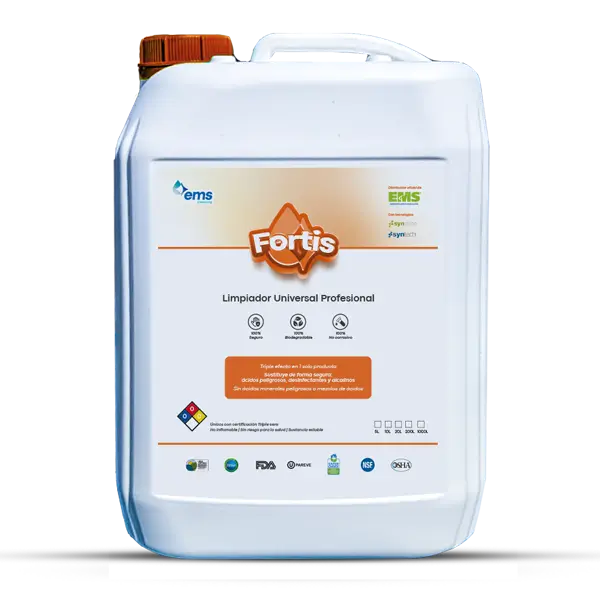
Fortis is a concentrated detergent with a light amber color and a mild soapy scent, according to the product’s official website. It is designed to provide universal cleaning power combined with deodorizing properties. EMS Cleaning notes that it is suitable for bathrooms, trash areas, tile surfaces, outdoor equipment, and food processing facilities.
- Cleaning action: It is designed to remove limescale, mold, stubborn stains, and grease, and to replace traditional acidic and caustic cleaners in appropriate applications.
- Deodorizing and disinfecting properties: According to the manufacturer, Fortis eliminates bacteria and germs that cause unpleasant odors using XTREME technology. The specific efficacy must be confirmed for the intended use, concentration, and microorganisms specified in the hygiene plan.
- Wide compatibility: The official website lists chrome, paint, metals, stainless steel, rubber, and plastic, as well as tiles and other industrial surfaces.
- Safety Profile: EMS Cleaning states that the formula is neither corrosive nor toxic and that it has a Triple Zero rating from HMIS and NFPA. However, the facility’s risk assessment should be based on the current safety data sheet.
- Declared biodegradability: The manufacturer states that the product is 100% biodegradable within 10 days. This claim must be retained along with the technical documentation and test conditions when preparing the internal dossier.
The key word is “appropriate.” Fortis should not be presented as an automatic solution for any type of buildup, equipment, or circuit. In a food-processing facility, a distinction must be made between cleaning open surfaces and cleaning closed circuits. This article focuses on accessible surfaces: floors, walls, tiles, containers, waste areas, restrooms, exterior elements, and equipment that can be safely rinsed.
Would you like to test Fortis in a landfill or industrial area?
Request a technical recommendation for selecting the test area, surface, and verification method.
3. Technical Procedure for Acid-Free Industrial Cleaning
A well-designed acid-free industrial cleaning program does not begin by pouring the product all over the facility. It starts with a simple application sheet: surface, type of dirt, frequency, current method, known risks, and acceptance criteria. With this information, you can compare the conventional process with Fortis without attributing performance to the product that has not yet been observed.
Step 1. Identify the dirt and remove the excess
For acid-free industrial cleaning, remove solids, food debris, accumulated grease, and any materials that may prevent the detergent from coming into contact with the surface. Use tools appropriate for the area and avoid pushing dirt into drains without control. In an area with debris, pre-removal reduces the load that the product must emulsify and facilitates the final inspection.
Step 2. Check the surface
When performing acid-free industrial cleaning, verify whether the surface is stainless steel, painted metal, rubber, plastic, tile, chrome, or another material. Although Fortis is marketed as compatible with various surfaces, test it on an inconspicuous area first, especially when there are coatings, aged seals, deteriorated paint, or metals of unknown composition. Do not mix products, and remove any residue from the previous cleaner by rinsing as indicated in the procedure.
Step 3. Prepare the application according to the technical data sheet
In acid-free industrial cleaning, Fortis is supplied as a concentrate. The official instructions are to dilute it according to the level of soiling, apply it, and rinse. The working concentration, temperature, contact time, and application method must be determined by EMS Cleaning or as specified in the current technical data sheet for each specific case; it is not advisable to establish a universal dilution ratio for all plants.
Step 4. Apply using controlled mechanical force
To complete acid-free industrial cleaning, apply the product evenly to the surface and keep it damp for the validated contact time. On floors, tiles, and containers, scrubbing with a compatible brush can be just as important as the chemical action. On outdoor equipment, work in sections to prevent the product from drying out. Protect food, packaging, electrical connections, and materials that should not get wet.
Step 5. Rinse and inspect
In acid-free industrial cleaning, the rinse removes loosened dirt and detergent residue. Use water and pressure appropriate for the area’s design, and check that there is no foam, film, stains, unusual odor, or buildup in joints and drains. On food-contact surfaces, the quality manager must determine whether additional verification is required before releasing the area.
4. Comparison of Decision Criteria
The following table is not a substitute for a safety data sheet or on-site validation. It summarizes the criteria that should be reviewed when comparing Fortis to a conventional acidic or caustic cleaner.
| Criterion | Conventional acidic or caustic cleaner | Fortis |
|---|---|---|
| Purpose of the Comparison | Remove a specific type of dirt using the existing method | Evaluate a universal alternative for appropriate surfaces and environments |
| Declared profile | It depends on the formulation and its safety data sheet | Non-corrosive and non-toxic, according to EMS Cleaning |
| Areas cited | Check compatibility on a case-by-case basis | Metal, stainless steel, rubber, plastic, paint, chrome, and tile, according to the official website |
| Usage Format | Follow the product information sheet exactly | Concentrate; dilute according to the level of dirt, apply, and rinse |
| Odors | It may require a separate check | Claimed deodorizing properties |
| Documentary Impact | Recording Hazards, PPE, Storage, and Waste Management | Keep the technical data sheet, MSDS, certifications, and application validation on file |
| Final Decision | Retain if it meets the validated criterion | Adopt only if it meets or exceeds the defined cleanliness and safety standards |
5. Where to Try Fortis First
The best pilot applications for acid-free industrial cleaning are those in which the team can observe the surface before and after cleaning, monitor the rinse, and stop the test without affecting a critical process. In acid-free industrial cleaning, areas with residue are a logical starting point: they accumulate grease, organic dirt, and odors, and typically include tiles, stainless steel, plastic, and washable floors. Industrial bathrooms, restrooms, containers, outdoor equipment, and surfaces in a food processing plant that are not in direct contact with the product can also be evaluated.
For each acid-free industrial cleaning test, it is important to record the date, the operator, the surface, the type of soil, the authorized dilution, the application method, the contact time, the rinsing process, and the visual result. Include observations regarding odor, foaming, film formation, visible corrosion, or changes in seals. If the area is part of an HACCP program, any changes must follow the company’s procedure for controlling suppliers and chemicals, with approval from the appropriate manager.
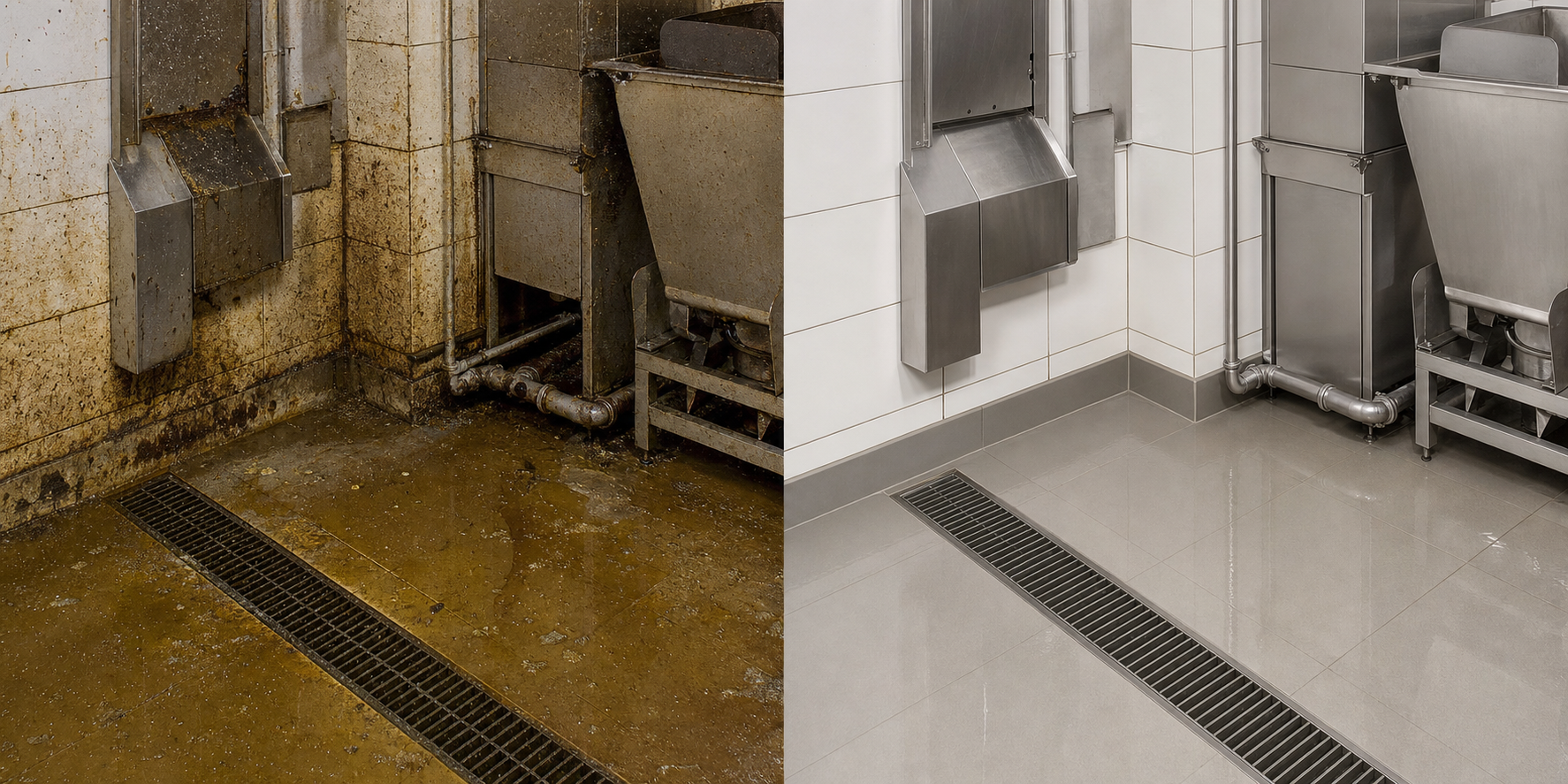
In acid-free industrial cleaning, “before and after” comparisons are useful for communicating the results, but they are not the only form of evidence. A visually clean surface may require additional testing if there is a microbiological risk or indirect contact with food. Similarly, a difference in color alone does not prove that mineral deposits have been removed. Define the acceptance criteria before beginning and use the same inspection method for all tests.
6. Safety, Documentation, and Limits of Substitution
Acid-free industrial cleaning reduces reliance on certain corrosive products, but it does not eliminate the need to follow a procedure. Personnel must be familiar with the safety data sheet, first-aid procedures, the use of appropriate gloves and eye protection, storage requirements, and spill response procedures. The “Triple Zero” classification assigned to Fortis does not replace the need to review current documentation or assess the facility.
In a regulated environment, keep the technical data sheet, the SDS, NSF documentation, or other approvals specified by the manufacturer, and the internal validation record. For a food facility, the substitution must be linked to the master cleaning plan, the hazard analysis, and the verification controls. If the procedure is intended for disinfection, request specific evidence supporting that claim and do not infer it solely from the fact that the product cleans or eliminates odors.
It is also important to distinguish between three scenarios. First, open surfaces that can be wetted and rinsed. Second, outdoor equipment or containers that require runoff control. Third, closed CIP loops, where compatibility, conductivity, solution return, and rinsing must be validated using a separate process engineering approach. Fortis may be a suitable candidate for a specific application, but the decision must be based on the technical data sheet, the equipment design, and the manufacturer’s instructions.
7. Frequently Asked Questions About Fortis and Acid-Free Industrial Cleaning
Can Fortis be used as a substitute for any cleaning acid?
No. EMS Cleaning markets it as a substitute for traditional acidic and caustic cleaners in appropriate applications, but each type of dirt and surface requires testing. In cases of severe mineral deposits or closed-loop systems, the method must be verified using the technical data sheet and in consultation with the person responsible for the process.
Can Fortis be used in a food processing plant?
The official website lists the food industry among its applications. Before using it, define the area, avoid contact with food, set up the rinse cycle, and document the verification required by the facility’s HACCP system.
Is Fortis a disinfectant?
The manufacturer describes disinfecting properties and efficacy against bacteria and odor-causing germs. The facility must verify the indication, the microorganism, the concentration, the contact time, and the supporting evidence before classifying it as a disinfecting step.
What materials are compatible with Fortis?
EMS Cleaning lists chrome, paint, metals, stainless steel, rubber, plastic, and tile, among other surfaces. Always test the product on an inconspicuous area when dealing with a coating, sealant, or material whose composition is unknown.
How is Fortis applied?
It is supplied as a concentrate. The general instructions are to dilute according to the degree of soiling, apply, and rinse. The dilution ratio and contact time must be determined based on current technical documentation and a controlled test, not on a generic figure.
Are you looking for an alternative for cleaning industrial surfaces that relies less on acids?
Talk to EMS Cleaning about the application, the surface, and the necessary validation before changing your procedure.
Conclusion
Fortis offers a technical approach to evaluating acid-free industrial cleaning in waste areas, bathrooms, exterior surfaces, and certain areas of food processing plants. Its solution combines universal cleaning power, deodorizing properties, broad compatibility, and a declared non-corrosive and non-toxic profile. However, for acid-free industrial cleaning to be verifiable, proper substitution cannot be based solely on a marketing claim: it must be demonstrated through a representative test, acceptance criteria, comprehensive documentation, and approval by the hygiene system. In this way, the facility can reduce risks without losing technical control over the cleaning process.
Technical sources: Fortis's official website and Fortis's technical specifications.