
How to Remove Hardened Concrete Without Hydrochloric Acid: A Technical Guide Using Barracuda 10K
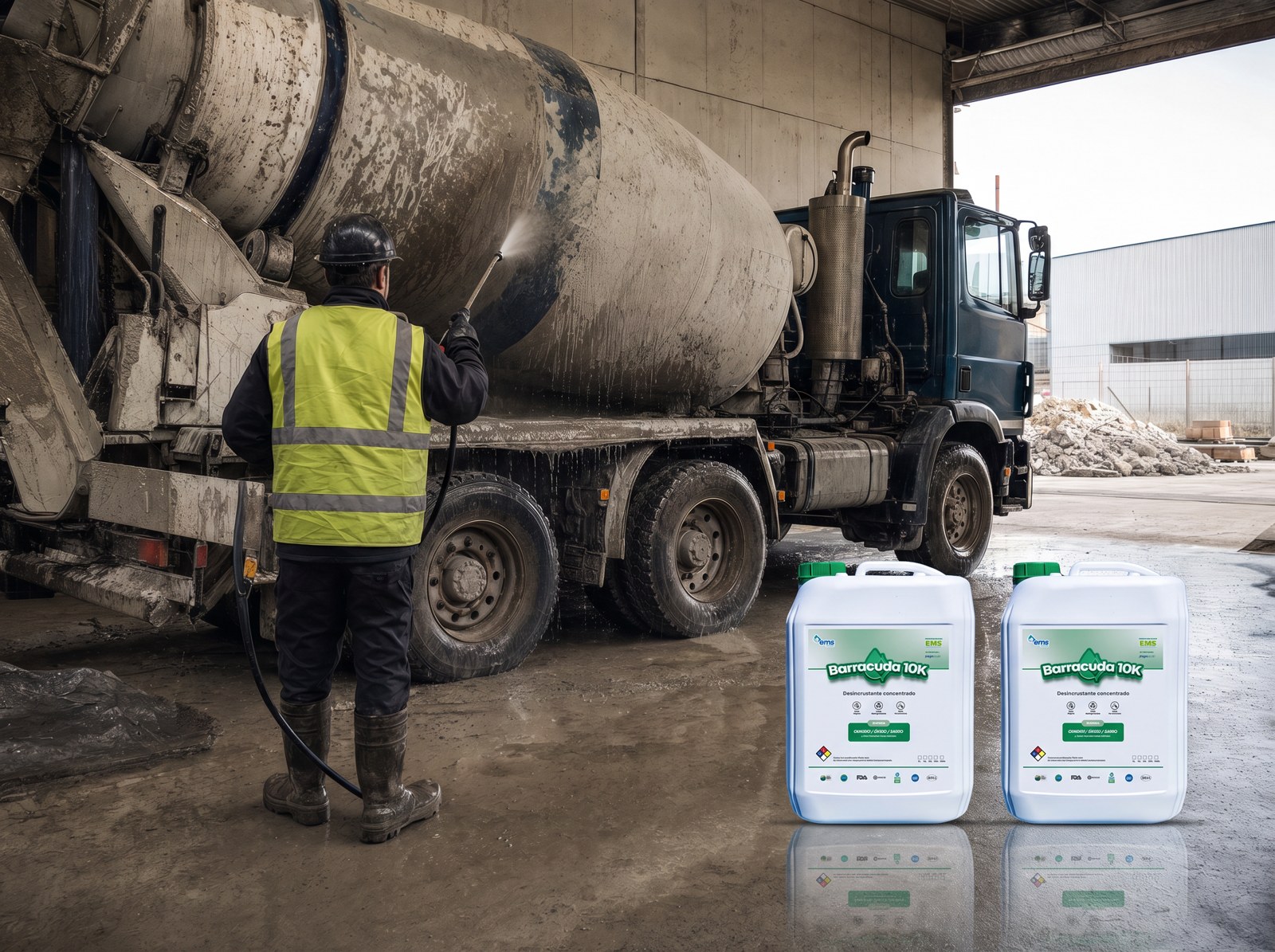
Cleaning hardened concrete is typically done using hydrochloric acid and mechanical force. This can damage paint, chrome, aluminum, wiring, and joints, in addition to producing fumes and creating management requirements. EMS Cleaning’s Barracuda 10K is a biodegradable, non-corrosive descaler for concrete, lime, scale, rust, and other buildup. Here, we explain how to evaluate it without turning a marketing claim into a universal promise.
The goal is to establish a repeatable procedure: identify the deposit, protect the equipment, select the dilution, ensure proper contact, rinse, and inspect. Barracuda 10K can replace hydrochloric acid only after a representative test and review of the current safety data sheet.
1. Why bonded concrete requires controlled descaling
Fresh concrete contains water, cement, aggregates, and additives. As it loses moisture, the cementitious matrix hardens and becomes embedded in threads, blades, gutters, tanks, and tools. The residue may consist of a mixture of cement, sand, lime, rust, and grease, so a method that works on a thin stain may not necessarily work on a thick crust.
The first step is to distinguish between organic dirt and mineral deposits. A degreaser can emulsify oil, but it is not designed to dissolve cured concrete. Conversely, a descaler can act on cement and lime, but it does not replace a degreasing step when equipment is covered in oil or fuel. Barracuda 10K is intended for concrete, rust, scale, and other deposits; the cleaning plan should separate each phase and avoid mixing chemicals.
2. What Barracuda 10K Offers as an Alternative to Hydrochloric Acid
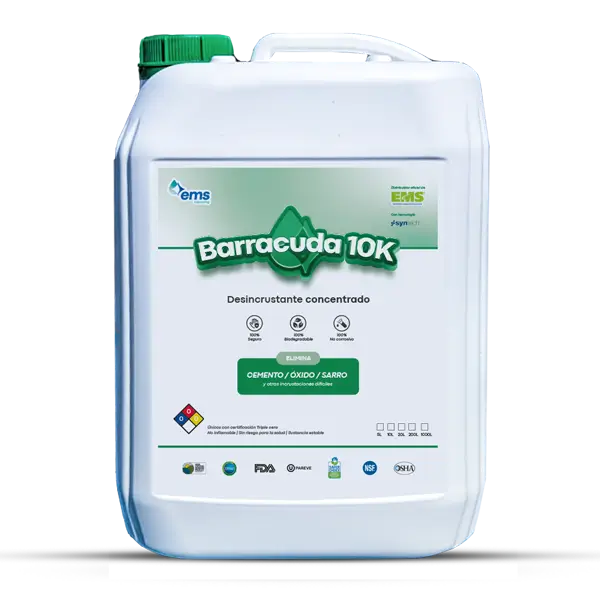
The official website describes Barracuda 10K as a biodegradable, non-toxic descaler for removing concrete, lime, scale, and soot from various surfaces. The technical data sheet describes it as a liquid, water-soluble product formulated with synthetic acid; it also indicates a Triple Zero HMIS classification: non-flammable, non-hazardous to health, and stable. These descriptions should be read in conjunction with the safety data sheet and the facility’s risk assessment.
Some of the key features to look for in an assessment include:
- Flexible application: The instructions call for spraying or soaking, with dilution depending on the degree of soiling, followed by rinsing with water.
- Contact time: The instructions specify 1 to 10 minutes for general application; the solution must not dry.
- Declared compatibility: EMS Cleaning lists paint, chrome, wiring, plastic, aluminum, and glass, but requires a localized test.
- Environmental profile: The data sheet indicates 100% biodegradability and the absence of nitrates; keep the documentation and review the disposal process.
- Special equipment: The form mentions ultrasound machines, provided that the equipment and procedure are validated.
EMS Cleaning’s marketing materials also claim that Barracuda 10K can dissolve 15% more concrete than hydrochloric acid, according to independent tests cited by the manufacturer. That figure should not be automatically applied to every job site: the surface, the thickness of the deposit, the dilution ratio, the duration, and the comparison method must be documented before drawing any conclusions.
Would you like to test the Barracuda 10K on a concrete mixer or construction equipment?
Request a technical recommendation to select the test surface and define the validation method.
3. Procedure for Removing Concrete Without Hydrochloric Acid
A change in chemical must be documented as a clear work instruction. Before beginning, identify the equipment, materials, tank type, access, drainage, and acceptance criteria. The following sequence serves as a test framework for Barracuda 10K; the specific concentration must follow the table in the technical data sheet or the supplier’s recommendation.
Step 1. Isolate the equipment and remove the excess
Stop the machine, apply the appropriate safety lockout, and remove tools, materials, and product from the area. Use a compatible scraper to remove loose concrete fragments, taking care not to strike joints, wiring, or paint. If oil, grease, or fuel is present, separate them from the mineral deposit and perform a preliminary cleanup using the appropriate product. Do not direct debris toward a drain without runoff control.
Step 2. Identify materials and conduct a spot test
Check whether the area contains painted steel, stainless steel, aluminum, copper, chrome, plastic, rubber, glass, or wiring. Although the Barracuda 10K documentation states compatibility with a wide range of materials, a spot test can detect changes in luster, discoloration, softening of joints, or reactions on delicate metals. On surfaces of unknown composition, start with a small spot and document the result before expanding the treatment area.
Step 3. Choose the working dilution
The technical data sheet recommends a ratio of one part product to one part water for extreme cases; two parts water to one part product for severe cases; four parts water to one part product for heavy cases; six parts water to one part product for moderate cases; and undiluted product for the application indicated on new or used equipment. These ratios are manufacturer’s guidelines, not an authorization to disregard the current technical data sheet or the risk assessment.
Prepare the solution in a compatible container that is properly labeled and secured. Avoid mixing Barracuda 10K with chlorine, lye, other acids, disinfectants, or residues from previous products. If the facility uses automatic dosing based on conductivity, first verify the reading and operating range with the person in charge of the equipment.
Step 4. Apply the product and keep the surface moist
Apply by spraying, brushing, controlled foaming, or immersion, depending on the part's geometry and the approved procedure. Cover the scale without unnecessarily wetting electrical connections or areas that should not get wet. Keep the product moist for 1 to 10 minutes and observe the reaction. The goal is to allow time for descaling without letting the solution dry out.
If a thick crust has formed, gradual mechanical removal may be necessary. Use a brush, sponge, spatula, or compatible tool after the specified contact time has elapsed. Do not force any moving parts, and do not use a tool that could damage the base. If the deposit does not come off, record the result and check the dilution, access, and sequence before extending the contact time based on your judgment.
Step 5. Rinse, inspect, and repeat only as necessary
Rinse with water that is compatible with the equipment and the collection system. Check that no film, fragments, foam, or retained solution remains in threads, cavities, joints, or channels. The surface must be inspected using the same method used prior to the test. If a crust remains, this does not mean it is safe to increase the concentration indefinitely: document the deviation and request a technical adjustment.
4. Comparison chart to help decide on a method
The comparison should take into account performance, safety, materials, application, and rinse management. The table summarizes the criteria for evaluating Barracuda 10K versus hydrochloric acid.
| Criterion | Hydrochloric acid / muriatic acid | Barracuda 10K |
|---|---|---|
| Target Deposits | It may affect minerals; check the formulation and surface | Concrete, lime, scale, rust, and other deposits, according to EMS Cleaning |
| Vapors | Exposure and ventilation must be monitored | The data sheet indicates the absence of toxic vapors and gases |
| Corrosion | This should be evaluated with particular attention to metals, joints, and coatings | The documentation describes it as non-corrosive; verify locally |
| References | Compatibility on a case-by-case basis | Paint, chrome, wiring, plastic, aluminum, and glass, according to the spec sheet |
| Application | Follow the label, MSDS, and procedures specific to the product | Spray or soak; dilute depending on the level of dirt, then rinse |
| General Contact Information | According to the product specifications for this specific item | 1 to 10 minutes, according to the technical specifications |
| Neutralization | Define it in the procedure and in the discharge plan | The official website states that no additional neutralization steps are required; please confirm with the center |
| Final Decision | Keep only if it meets safety, material, and performance standards | Adopt only after a representative and documented test |
This table does not replace a Material Safety Data Sheet (MSDS) or an environmental permit. In particular, “non-corrosive” does not mean that eye protection, gloves, or splash control can be omitted. Barracuda 10K must be handled like any other maintenance chemical: with up-to-date documentation, proper storage, training, and an emergency procedure.
5. Where it fits into construction, transportation, and maintenance
The most practical applications combine mineral reservoirs with direct access. In concrete mixers, chutes, shovels, drums, tools, and removable components can be tested while avoiding electrical areas and controlling wash water. In precast, transportation, and machinery plants, testing may include tools or parts coated with concrete, lime, or rust, while protecting paint, plastic, aluminum, and glass.
The food and restaurant industries are also listed among the sectors identified by EMS Cleaning, but that does not mean that any production equipment automatically qualifies for this application. For surfaces in contact with food, isolation, rinsing, decontamination, and verification must be defined in accordance with HACCP. For closed-loop tanks, heat exchangers, or piping, the process differs: circulation, return flow, materials, conductivity, and the absence of residues must be checked before the equipment is reused.
In ultrasonic machines, Barracuda 10K should be used only if the tank and parts have been validated. For aluminum, copper, or tin-coated radiators submerged in undiluted product, the data sheet indicates that they should be removed after 15 minutes because they may react; include this warning in the work instructions.
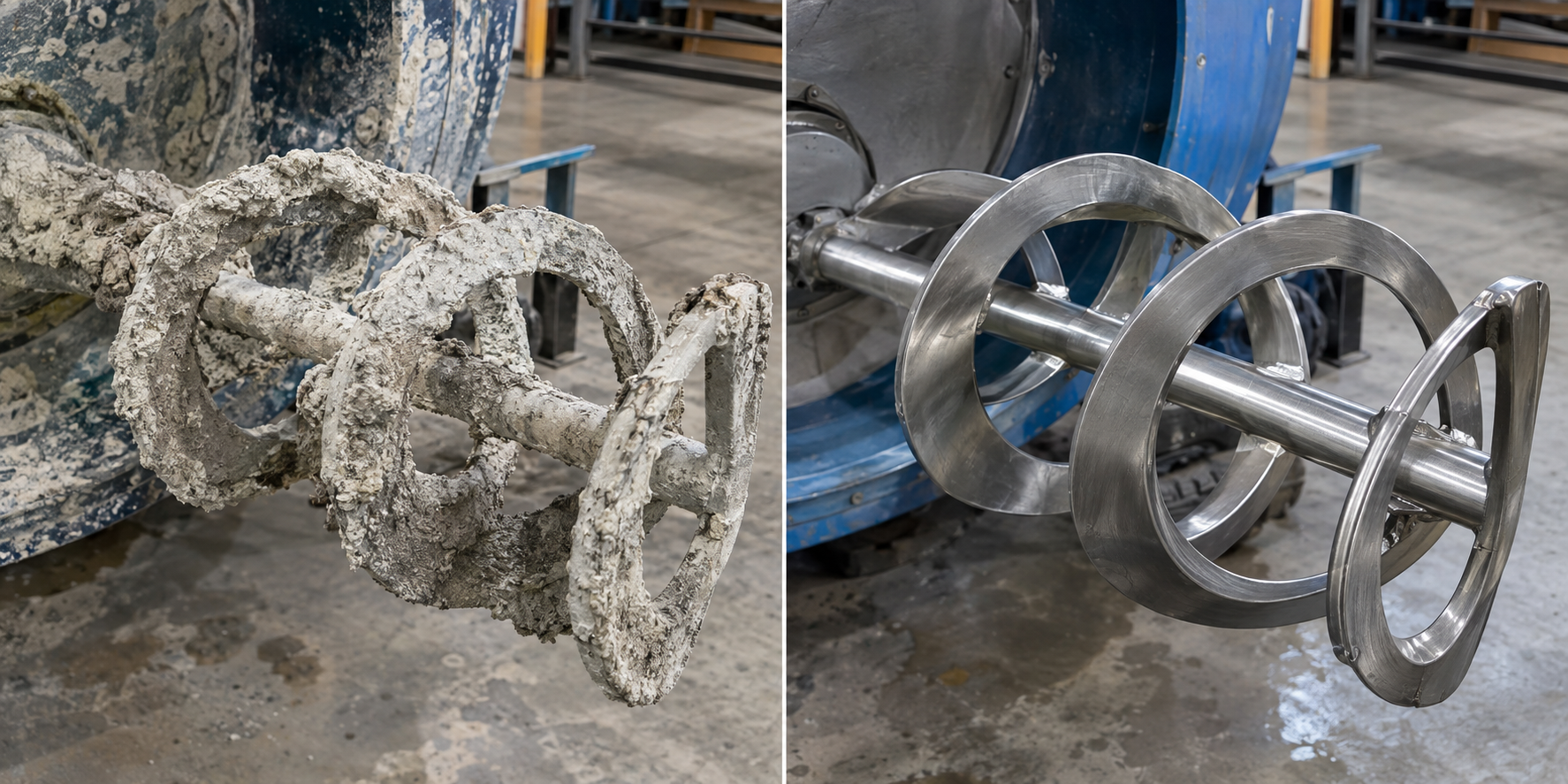
The before-and-after image helps convey the purpose of the test, but it does not, on its own, prove compatibility or complete removal. Include inspections of joints, threads, welds, cavities, and drain points. For critical equipment, combine visual inspection with the monitoring procedures already in place in the maintenance plan.
6. Documentation, REACH, Safety, and Disposal
Replacing hydrochloric acid with a product that has a different risk profile may simplify some aspects of management, but it does not eliminate the facility’s obligations. Keep the technical data sheet, the SDS, the batch number, the materials assessment, the application procedure, the training record, and the test results. The REACH and CLP compliance review must be based on current documentation and actual use in Spain; simply copying a statement from a commercial website is not sufficient.
Internal labeling must identify the product, dilution, application area, and incompatibilities. Although EMS Cleaning specifies “Triple Zero,” the safety officer must specify the required gloves, goggles, work clothing, ventilation, and spill response procedures. The safety data sheet indicates that, in case of inhalation, the eyes or skin should be rinsed with plenty of water for 15 minutes and the person should be moved to fresh air; the facility’s procedure must be available at the point of use.
The management of rinse water depends on the type of contaminants removed, the process, the discharge permit, and local regulations. “Biodegradable” does not mean automatic permission to discharge into any body of water. Recover solids, control runoff, and confirm with the environmental manager how the effluent should be treated. During an audit, a substitution is justifiable when the company can demonstrate the rationale, validation, controls, and final decision.
7. Frequently Asked Questions About the Barracuda 10K
Can Barracuda 10K always be used as a substitute for hydrochloric acid?
There is no one-size-fits-all solution. EMS Cleaning offers this as an alternative for concrete, lime, scale, rust, and other deposits, but each piece of equipment has different materials, thicknesses, and conditions. Conduct a spot test and compare the results with your current method before changing your entire procedure.
What dilution should be used?
The product data sheet recommends a dilution range from undiluted to one part product to six parts water, depending on the severity of the problem and the type of application. Use the dilution ratio specified in the current product data sheet and adjust it only through a controlled test. Do not mix the solution with other chemicals or improvise a concentration for a surface that has not been tested.
How long should it remain on the concrete?
The general instructions specify a contact time of 1 to 10 minutes. Keep the surface damp, monitor the reaction, and use appropriate mechanical action when necessary. When immersing certain radiators in undiluted product, the data sheet recommends removing the parts after 15 minutes; this warning should not be applied to other materials.
Is it safe for paint, aluminum, glass, and wiring?
EMS Cleaning's documentation lists these materials as compatible, but actual compatibility depends on the finish, condition, and duration of exposure. Protect connections, test the product in an inconspicuous area, and check for changes in gloss, color, joints, or coatings before expanding the application.
Can it be used in a concrete mixer or an ultrasonic machine?
The page and the data sheet mention construction equipment, tools, and ultrasonic machines. For a concrete mixer, isolate the equipment and monitor the rinse water; for ultrasonic machines, confirm the compatibility of the tank and parts. In both cases, the procedure must be approved following a representative test.
Do you need to remove concrete, lime, or rust without using hydrochloric acid?
Share the equipment, supplies, and tank type with EMS Cleaning to schedule a Barracuda 10K trial.
Conclusion
Removing hardened concrete isn’t about choosing the most aggressive chemical. It’s about controlling the application, the surface, the dilution, the contact time, the mechanical action, the rinsing, and verifying the results. Barracuda 10K offers a technical alternative that EMS Cleaning describes as biodegradable, non-corrosive, and suitable for various types of deposits and materials. The responsible way to use it is to start with a representative area, follow the current safety data sheet, and document the decision regarding hydrochloric acid.
Technical sources: Barracuda 10K official website and Barracuda 10K technical specifications.