
Swimming pools in Spanish residential complexes, hotels, and water parks face a silent enemy: limescale. In regions such as Catalonia, the Levante, the Balearic Islands, and Andalusia, water hardness frequently exceeds 30 °f, and calcium carbonate and magnesium systematically deposit on the waterline, inside skimmers, on jet nozzles, in heat exchangers, and—most critically—inside recirculation pipes. The result is the same every season: reduced flow, clogged filters, pumps operating beyond their design capacity, premature galvanic corrosion, and ever-rising repair bills. For decades, the solution has always been the same: cold-applied hydrochloric acid (HCl). But HCl burns, corrodes, contaminates, and exposes operators and swimmers to an avoidable risk. The good news is that there is a real, approved alternative: a biodegradable, non-toxic pool descaler for community pools that is compatible with all pool shell and hydraulic system materials. It’s called WaterSafe60, and it’s changing the way community pool maintenance is done in Spain.
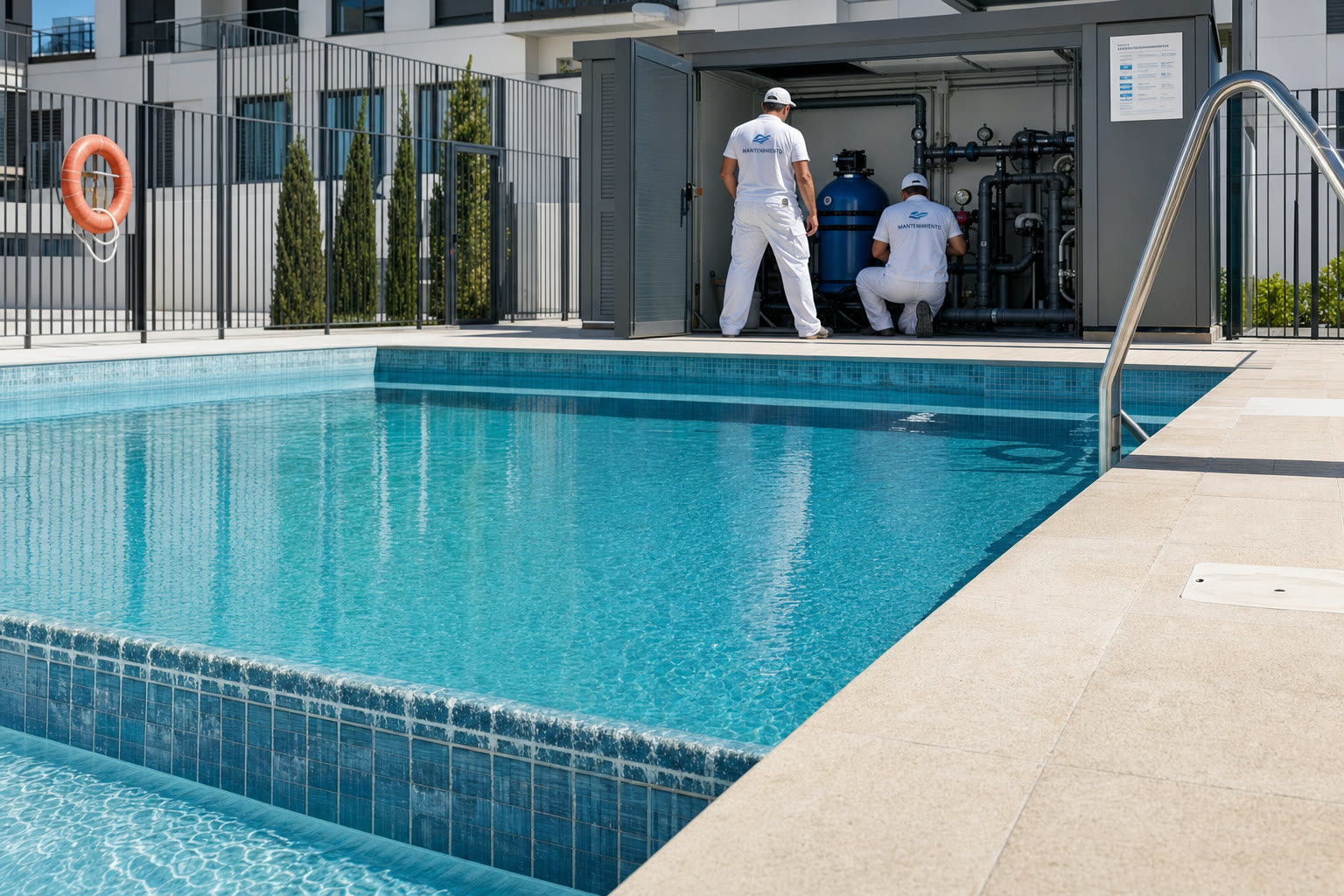
Why do limescale and deposits form in community swimming pools?
Lime buildup in community swimming pools is a purely chemical phenomenon. In most parts of Spain, tap water has a high concentration of calcium (Ca²⁺) and magnesium (Mg²⁺) ions. When that water is heated—in heated pools, spas, or simply by solar radiation—or when the pH rises above 7.6, these ions precipitate as calcium carbonate (CaCO₃) and magnesium hydroxide (Mg(OH)₂). The well-known Langelier Index (LSI) explains this tendency: positive values indicate precipitation, while negative values indicate aggressiveness. In autonomous communities where hard water scaling is endemic in Spain, the LSI remains positive almost all year round.
The areas where scale builds up are always the same:
- Waterline and tile border: the visible white edge that worries homeowners.
- Skimmers and overflow grates: reduction in suction flow.
- Discharge nozzles: reduction in return flow velocity.
- Sand or glass filters: the filter bed becomes cemented and loses its effectiveness.
- Heat exchangers for heated swimming pools: a drastic drop in thermal efficiency, with gas or electricity consumption increasing by up to 30%.
- PVC pipes and manifolds: reduction in the effective cross-sectional area.
The financial damage is direct and measurable. A scaled heat exchanger uses more energy, a scaled pump consumes more kWh, a clogged filter must be replaced prematurely, and a community with visible stains loses perceived value. That’s why more and more property managers are looking for a pool descaler for community pools that acts preventively, not just as a cure. Added to this is reputational damage that no property manager wants: complaints at homeowners’ association meetings, claims on hotel booking platforms, and negative reviews.
The Problem with Hydrochloric Acid and Other Traditional Descaling Agents
23–33% HCl has been the “standard” for decades for removing pool scale without acid…well, with acid. It’s cheap, works fast, and dissolves calcium carbonate in minutes. But the hidden costs are enormous:
Risks to operators. Hydrochloric acid is classified as a Category 1B corrosive under CLP. It causes severe chemical burns to the skin and eyes, and its vapors severely irritate the respiratory tract. Any splash in a technical work area requires full PPE: nitrile gloves, full-face goggles, a face shield, an apron, and a respirator with an E-filter. A moment of carelessness could land you in the emergency room.
Risks to swimmers. Even if applied outside of operating hours, residues can cause sudden changes in pH and release chloramines if hypochlorite is present in the pool. In poorly ventilated pools, there have been documented instances of trichloramine forming as a result of a reaction with organic matter.
Damage to equipment. HCl attacks neoprene and EPDM gaskets, corrodes AISI 304 stainless steel screws, degrades the cement grout in mosaic tiles, and causes pitting in titanium heat exchangers if free chlorides are present. Each application shortens the installation’s service life by several years.
Disposal issues. It is prohibited to discharge residual HCl into the sewer system without first neutralizing it with caustic soda or sodium carbonate; the mixture releases heat and CO₂. The rinse water from acid cleaning is classified as a hazardous waste under code LER 06 01 02*.
Legal framework. HCl is subject to REACH (mandatory registration), the ADR regulations for road transport (Class 8, Packaging Group II), and Royal Decree 656/2017 on the storage of chemicals, which requires spill containment trays, forced ventilation, and safety distances. For a homeowners’ association, complying with all of these requirements is practically impossible.
WaterSafe60: The Biodegradable Alternative for Removing Limescale from Swimming Pools
WaterSafe60 is a biodegradable pool descaler developed by EMS Cleaning and distributed in Spain and Portugal by Kefi Bosque Group S.L. It is not a conventional acid in disguise: it is a specific formulation designed to dissolve carbonates, sulfates, and silica deposits without the risks associated with HCl. All technical information is available in the official WaterSafe60 product sheet.
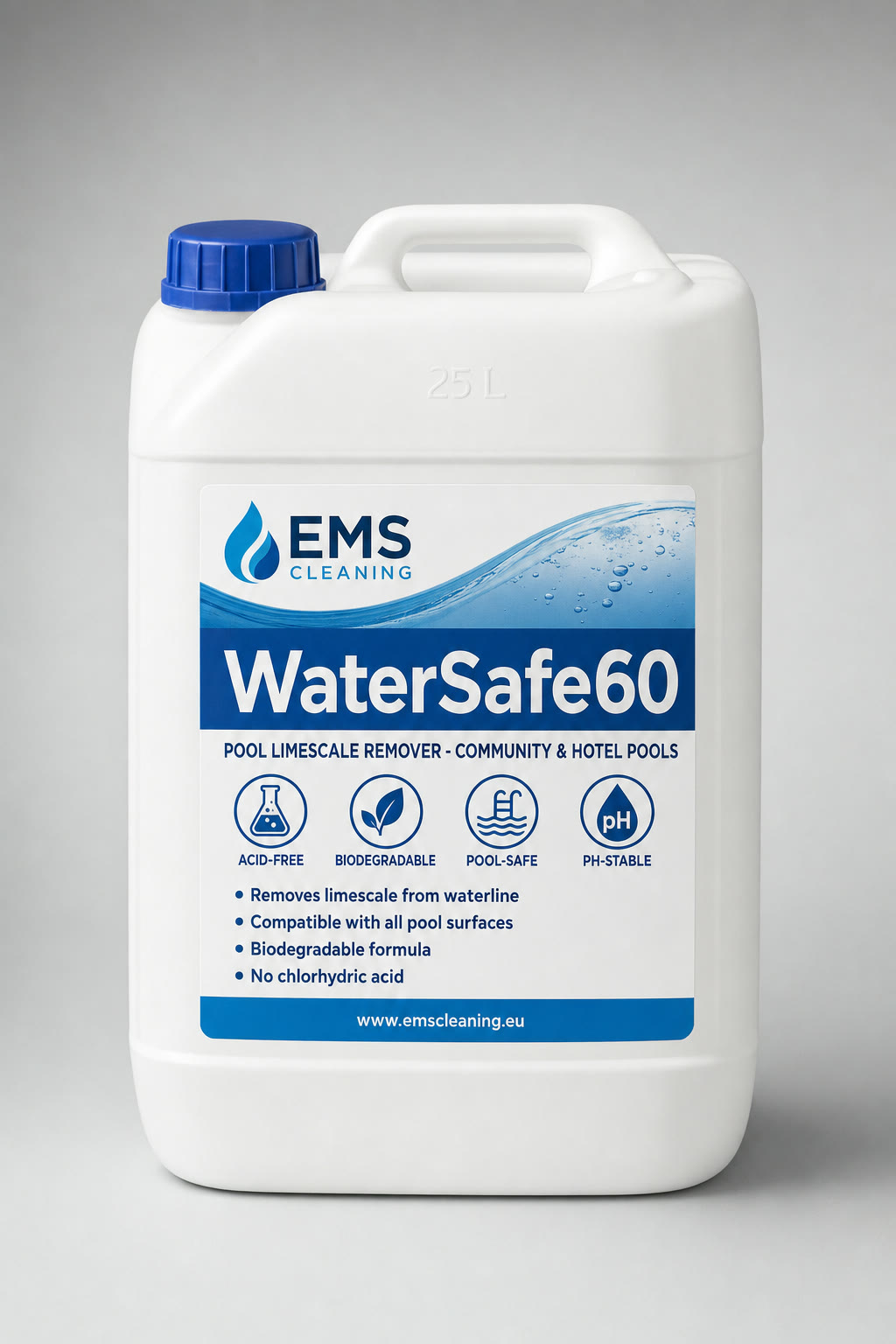
Its hallmark is the Triple Zero certification:
- Non-flammable: does not burn, has no flash point, and does not require ATEX storage.
- No health risk: Not classified as toxic, does not produce harsh vapors, and does not require PPE for corrosive substances.
- Stable substance: does not react violently with oxidizing agents, does not release gases when mixed with residual hypochlorite, and does not polymerize.
In addition, WaterSafe60:
- It is biodegradable according to OECD criteria.
- It regulates the pH during application, preventing the sudden spikes typical of acid.
- It operates in-line (with the pool full and the circulation system running) and off-line (intensive cleaning of the empty pool system).
- It can be diluted to concentrations ranging from 5% to 100% for aggressive pipe descaling.
- It is compatible with ceramic, mosaic tile, PVC, PVC-U, HDPE, reinforced polyester, AISI 316 stainless steel, titanium, and bronze.
These features make it the most versatile commercial pool anti-fouling product on the market for facilities where the safety of swimmers and staff is non-negotiable.
Would you like to try WaterSafe60 in your community or hotel before making a decision?
Request a free sample and a no-obligation technical evaluation.
Comparison: WaterSafe60 vs. hydrochloric acid
To ensure an objective decision, here is a direct technical comparison between traditional HCl and WaterSafe60 as pool descaling agents for community pools:
| Criterion | Hydrochloric acid (HCl) | WaterSafe60 |
|---|---|---|
| Worker Safety | Corrosive 1B, full PPE required, risk of burns | Non-corrosive, no burns, basic PPE |
| Environmental Impact | Non-biodegradable, hazardous waste LER 06 01 02* | Biodegradable, leaving no hazardous residue after natural neutralization |
| Device Compatibility | Attacks joints, 304 stainless steel, grout, and titanium containing chlorides | Compatible with ceramic, PVC, polyester, 316 stainless steel, and titanium |
| Price per liter | Low (0.4–0.8 €/L) | Moderate, but lower total cost (fewer replacements, less damage) |
| Application time | Fast, but requires neutralization and intensive rinsing | In-line application without draining the pool, without a prolonged shutdown |
| REACH | Registered, with restrictions on professional use | Complies with REACH without any special restrictions on use |
| NFPA 704 Hazard Level | Health 3 – Flammability 0 – Reactivity 1 | Health 0 – Flammability 0 – Reactivity 0 (Triple Zero) |
The data in the table speaks for itself. Although HCl has a lower purchase price per liter, the total cost of ownership (TCO) clearly works against it: higher insurance premiums, PPE expenses, accelerated replacement of gaskets and filters, potential fines for improper storage, and hours during which the pool is closed to the public. WaterSafe60, when applied in-line, prevents the loss of days during peak season—which, for a hotel on the Costa Brava or Costa del Sol, can mean thousands of euros in cancellations.
In addition, the NFPA 704 “triple zero” rating allows the product to be stored in the same utility room where hypochlorite or the pH reducer is kept, without additional requirements for forced ventilation, ATEX-compliant sumps, or minimum distances. For a property manager, this means regulatory compliance without the need for construction work.
How to Apply WaterSafe60 in a Community Pool: A Step-by-Step Guide
Proper, sustainable pool maintenance begins with a thorough assessment. Here is the recommended procedure for descaling with WaterSafe60:
- Preliminary diagnosis. Measure the total water hardness using a photometer (ideally below 30 °f after application), the pH, total alkalinity (TAC), and combined chlorine. Visually inspect the waterline, skimmers, nozzles, and, if possible, use an endoscope or cut open a section of pipe to assess the thickness of the scale buildup.
- Circuit Preparation. In in-line mode, isolate the expansion tank, if present, and confirm that the recirculation pump can operate throughout the entire cycle. In off-line mode, drain the section to be treated and install blind flanges to create a closed loop with a transfer pump.
- Dosage. WaterSafe60 can be diluted between 5% and 100% depending on the severity of the problem. For monthly preventive maintenance, low concentrations are sufficient; for severe scale buildup in pipes, use the product at 100% concentration. The exact dosage depends on water hardness, the tank volume, the type of scale, and the materials. We recommend always consulting an EMS technician before the first application to determine the correct dosage.
- Circulation and contact time. In in-line mode, the product is distributed by the system’s normal circulation. Typical contact times range from 4 to 24 hours, depending on the thickness of the deposit. In off-line mode, the product is recirculated using a transfer pump for 2 to 8 hours.
- Rinsing and verification. Rinse with clean water, filter out the dissolved CaCO₃, and refill the container. WaterSafe60 does not require aggressive chemical neutralization, but it is advisable to backwash the filter when finished.
- Final pH check. Before reopening the pool to the public, verify that the pH is between 7.2 and 7.6 and that the free chlorine level is within the proper range. If necessary, adjust using the usual pH increaser or decreaser.
This methodology is designed to be carried out by the community’s or hotel’s in-house maintenance team, without the need to hire a specialized company to handle corrosive substances.
Real-world use cases: communities and hotels in Spain
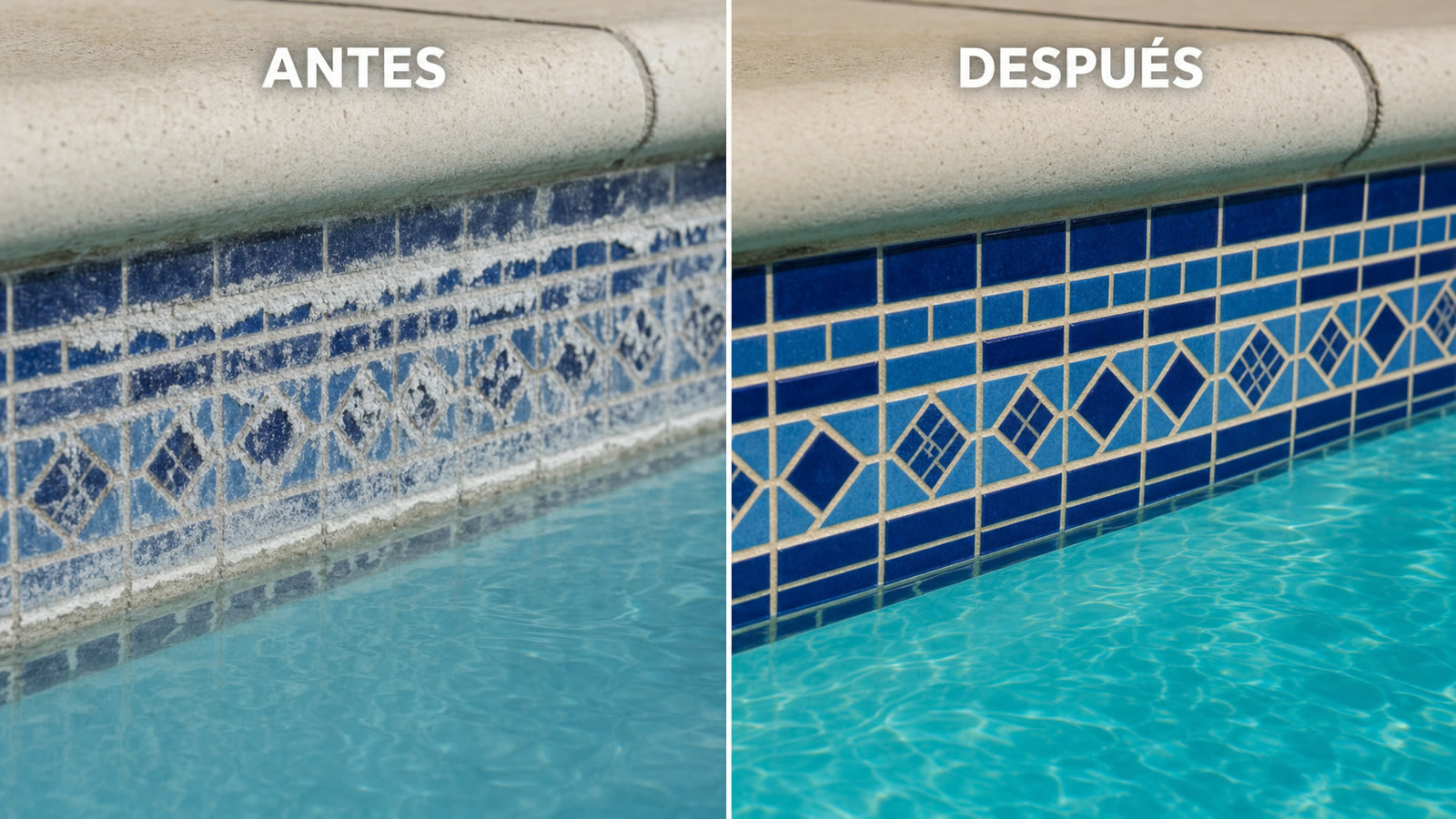
These are anonymized examples of the types of results being achieved with WaterSafe60 in the Iberian market:
Residential community in the Barcelona metropolitan area. A complex of 180 homes with three pools (adult, children’s, and indoor heated). After replacing the annual HCl treatment with a preventive maintenance program using WaterSafe60 applied in-line every quarter, the community reported a 30% reduction in total chemical consumption after twelve months, in addition to completely eliminating complaints about stains at the waterline.
A hotel chain with three properties on the Costa Brava. Complete transition from hydrochloric acid to WaterSafe60 for cleaning heat exchangers and recirculation circuits. Main benefit: elimination of HCl inventory in the mechanical rooms, resulting in a reduction in the civil liability insurance premium and the cost of the annual occupational safety and health audit.
Levante Municipal Water Park. Facility with daily preventive treatment using low doses of WaterSafe60 in the slide circuit and the wave pool. Result: zero unscheduled shutdowns throughout the entire summer season and estimated energy savings from keeping the plate heat exchangers clean.
These three sectors—residential communities, the hospitality industry, and municipal recreational facilities—account for 90% of the potential market in Spain, and in all of them, the decisive factor has been the combination of technical performance and safety for the end user. Adopting a biodegradable pool descaler for residential communities is not just an environmental issue: it is an operational decision that reduces downtime, workplace hazards, and maintenance costs.
Benefits for the Community Manager
Beyond its chemical performance, the use of a biodegradable pool descaler for community pools, such as WaterSafe60, offers management benefits that a property manager will immediately appreciate:
- Fewer complaints from homeowners about visible stains, cloudy water, or pools closed due to aggressive maintenance.
- Lower insurance risk: Since HCl and other corrosive substances are not stored on site, policy exclusions and unscheduled inspections are reduced.
- Simplified regulatory compliance: no ADR transportation requirements, no special APQ storage requirements, and no safety data sheets with GHS05 or GHS06 pictograms.
- CAPEX Savings: By protecting pipes, filters, heat exchangers, and salt-based chlorination systems, the replacement of expensive equipment is delayed.
- ESG Image: More and more communities and hotel chains are including environmental criteria in their specifications. Using biodegradable pool products is a concrete and verifiable selling point.
- Full traceability: EMS Cleaning provides technical data sheets, up-to-date MSDSs, and technical support in Spanish—something that many multinational suppliers do not offer.
You can view the entire line of complementary products in the EMS Cleaning product catalog, including biodegradable alternatives to other harsh industrial chemicals, such as SynClean HD, a biodegradable substitute for caustic soda.
Frequently Asked Questions
Is WaterSafe60 safe for swimmers if there is residue left behind?
Yes. WaterSafe60 is classified as non-toxic and biodegradable, and its Triple Zero certification ensures that it does not produce hazardous vapors or waste. Even so, standard protocol recommends flushing the system and checking the pH before reopening the pool, as with any maintenance product. It does not produce chloramines when it reacts with residual hypochlorite, unlike some conventional acids.
How long does it take to remove heavy buildup?
It depends on the thickness and composition of the deposit. For thin deposits at the waterline, the effect is visible within a few hours. For thick deposits in pipes or heat exchangers, the system operates in offline mode at 50–100% concentration for 4–8 hours of recirculation. For very old deposits, a second pass may be required; the EMS technical team determines the appropriate treatment after analyzing the sample.
Is it compatible with saltwater pools or salt chlorination systems?
Yes. WaterSafe60 is compatible with salt electrolysis systems and does not damage the titanium cells in chlorinators, provided that the recommended dosages are followed and the appropriate rinsing is performed. In fact, scale buildup on electrodes is a very common problem in saltwater pools, and this product is a safe alternative to conventional acid descalers for removing scale from the cell itself.
Can it be used in spas and hot tubs?
Yes. Its use in spas, hot tubs, and heated pools is essentially the same, although the dosages are adjusted to account for the smaller volume and higher temperature. Since it is nonflammable and does not produce vapors, it is particularly well-suited for enclosed or semi-enclosed spaces where HCl would be unacceptable for occupational safety reasons.
How do I request a free sample?
Through the EMS Cleaning Spain contact form, specifying the type of facility, tank volume, and main issue. The technical team will respond within 24–48 business hours with a trial proposal and, if applicable, will send a free sample to test the product on-site.
Conclusion and Call to Action
Removing limescale and mineral deposits from community and hotel swimming pools no longer requires the use of hydrochloric acid or exposing oneself to its risks. WaterSafe60 proves that it is possible to have a pool descaler for community pools that is effective, fast-acting, compatible with all pool and circulation system materials, safe for operators and swimmers, biodegradable, and in line with the 2026 regulatory and ESG requirements. Today, it is the technical benchmark for property managers, hotel maintenance directors, and municipal aquatic facility managers who want professional community pool maintenance without any surprises.
If you manage a homeowners' association, a hotel, a water park, or a sports center with a pool and want to stop using hydrochloric acid, now is the time.
Request your free sample of WaterSafe60 now
Our technical team will assess your system and propose a customized descaling plan, with no obligation.
For more technical information about WaterSafe60, please refer to the official product data sheet, or if you'd prefer to speak directly with a specialist, please contact our technical team.
EMS Cleaning Spain — Kefi Bosque Group S.L.
Av. Jaume Recoder 88, 8th Floor, Suite 4, 08301 Mataró (Barcelona)
Tel.: +34 634 293 241
Email: info@emscleaning.eu · sales@emscleaning.eu
Official distributor of EMS Cleaning for Spain and Portugal.